

GOSI Mistakes in Saudi Arabia: Why They Recur, and How to Stop Them Before the Fine
A small error in one employee record doesn't stay small. In Saudi Arabia, where GOSI, Mudad, Qiwa, and ZATCA are interlinked, a slip in a number or a date turns into arrears, then a monthly penalty, and can end in suspended government services. The frustrating part is that most of these errors don't originate in the salary calculation. They originate in the data that feeds it, which means they can be caught before they happen rather than after.
This article answers three questions every HR and finance lead in the Kingdom asks: how a small error becomes a large loss, why it recurs even with a capable team, and how to stop it before it becomes a violation.
How a small error becomes a large loss
Start with the scale. EY's study on the cost and risks of payroll errors found that average payroll accuracy sits at just 80%, meaning one in five payrolls contains an error. The average company makes around 15 corrections per pay period, at roughly $291 per error. Those are global numbers, but they're more dangerous in the Saudi context, because here an error doesn't only cost a correction. It carries a regulatory fine on top.
To see the snowball, follow one error's journey. It starts as a slip: a missing field, an outdated rate. It passes unnoticed and becomes an under contribution or a late file. The ministry issues an alert. As days pass, arrears accumulate with a 2% monthly late penalty. If it continues, the fine can reach thousands of riyals per employee, and in serious cases some government services are suspended or work visas blocked.
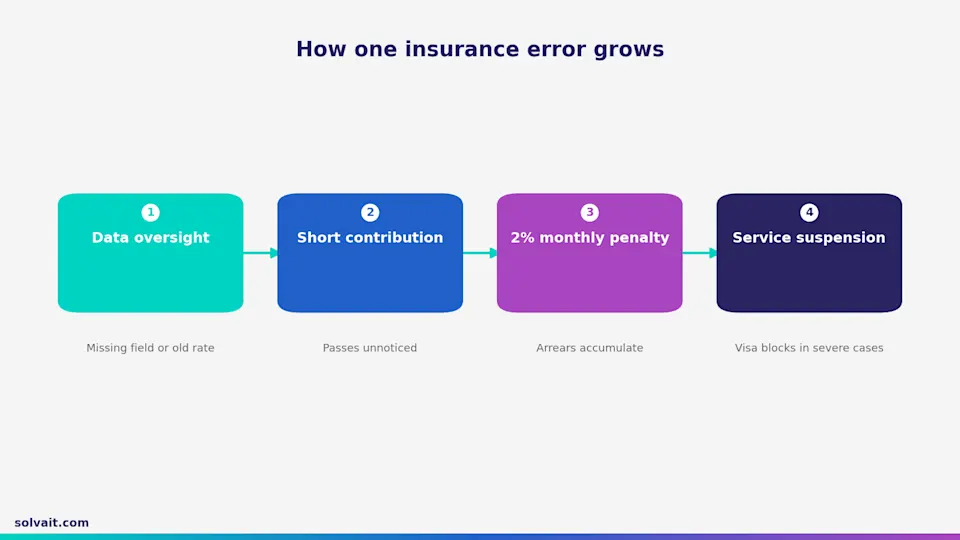
Five errors in particular repeat month after month, and each one starts small:
The error | How it starts | Where it ends |
Wrong contribution base | Contribution calculated on the wrong figure | Under contribution (violation) or over payment (direct loss) |
Old rate after July 2025 | Keeping the previous rate | Arrears plus a 2% monthly penalty |
Late Mudad submission | Missing the monthly upload window | Up to SAR 3,000 per employee |
Unregistered new hire | Late registration after start date | Up to SAR 10,000 per employee |
Mismatched WPS file | File doesn't match contracts | Service suspension and visa blocks |
What stands out in the table is that the middle column is simple: these are entry or timing errors, not complex calculation errors. That's exactly what makes them dangerous, because they pass quietly.
Why they recur, even with an HR team
The question that puzzles leadership: we have a capable team, so why does the same error keep coming back? The answer is that the problem sits in the design of the process, not in the competence of the people.
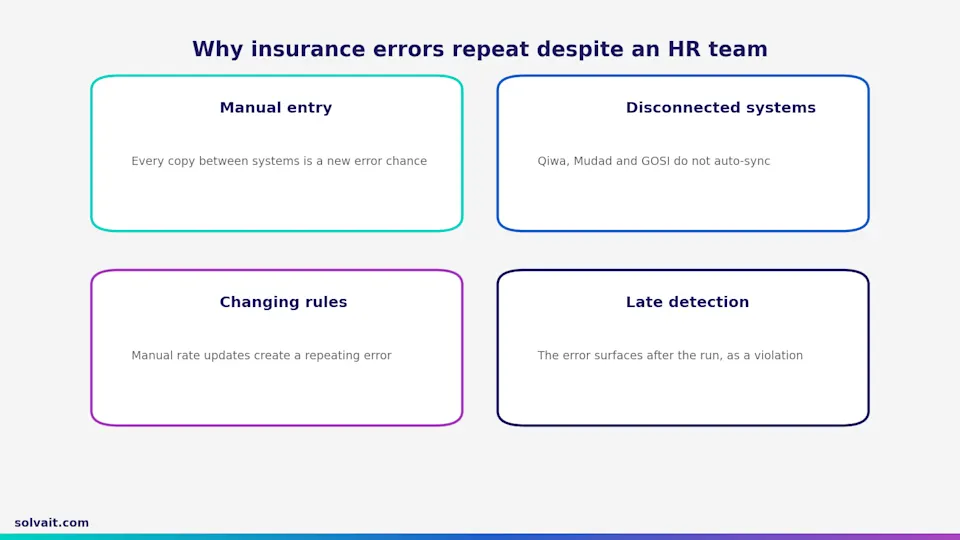
Four factors make recurrence almost inevitable.
Manual entry: When employee data is copied between systems by hand, each copy is a fresh chance for an error. An Iqama number mistyped once is enough to stall an entire file.
Siloed systems : In many setups, Qiwa, Mudad, and GOSI don't talk to each other automatically. The team is forced into repeated manual syncs, and each sync is a potential point of failure.
Shifting rules : The regulations don't hold still. The new Social Insurance System became operationally effective on July 3, 2025, and under it the pension contribution rate for new Saudi employees, those with no prior contributions before July 3, 2024, rises by 0.5% per year for both employer and employee until 2028. Any late manual update to this rule produces an error that repeats every cycle until someone catches it.
Late detection : The most dangerous factor. When the error surfaces after payroll has run, it has already become a violation. The team isn't making more mistakes than anyone else, but it finds them late, so it pays twice: a correction and a fine.
Notice the common thread across all four: time. Each factor places detection after the moment of harm, not before it. And that points straight at the fix.
How to prevent these errors before they become fines
The one difference that turns these mistakes from surprises into non events is the timing of detection. Catching an incomplete profile after payroll has run means a costly correction and a likely fine. Catching it before the run means a single click. The rule is simple: move the check to before the run.
This is where agentic AI comes in. The pre payroll employee profile validation feature, logged in the feature bank under ID F-046, checks thousands of profiles before the run and flags exactly what feeds the five errors: a missing bank account, missing ID or Iqama, contract gaps, or salary anomalies. Feature F-044 covers the GOSI setup, transactions, and reports experience. With this, compliance shifts from a monthly race against the clock to a quiet process that catches the error at its source.
And because all four factors come down to time and connection, they share one remedy: a platform that links employee data to payroll to GOSI in one place, runs validation before every cycle, and applies the updated regulatory rule automatically.
Where does Solvait's role stand out?
Solvait HCM, built on Microsoft Dynamics 365, brings employee data, payroll, and GOSI into one system, closing the gap between the siloed systems that cause half the errors. It runs agentic validation before every cycle, so all five mistakes are caught where they originate, before they become arrears or fines. And because the platform is built for the Saudi market, GOSI and Wage Protection System rules live in the system, not in an employee's memory.
And to be honest: the tool won't excuse your team from knowing the regulations, nor should it. But it ensures a passing human slip doesn't turn into a costly violation.
If you want to see pre payroll validation run on your data, book a demo.
FAQ
How does a small GOSI error become a large loss?
It starts as a slip in a field or a rate, passes unnoticed, and becomes an under contribution or a late file. The system then issues an alert, arrears accumulate with a 2% monthly late penalty, and the cost can reach thousands of riyals per employee or suspended government services. The cost compounds the longer detection is delayed.
Why do GOSI errors recur even with an HR team?
Because the cause sits in process design, not in people's competence. Manual entry, the disconnect between Qiwa, Mudad, and GOSI, changing regulatory rules, and detection after payroll runs all make the error repeat every cycle until it's caught late. The fix is validating data before the run, not after.
What is the new GOSI rate after July 2025?
Under the new system effective July 3, 2025, the pension contribution rate for new Saudi employees (with no prior contributions before July 3, 2024) rises by 0.5% per year for both employer and employee until it reaches its cap in 2028. Employees with prior contributions keep their existing rates.
How do I prevent GOSI errors before they become fines?
By moving the check to before payroll runs. Pre payroll validation flags missing fields, outdated rates, and mismatched files before the upload, turning an error from a violation into a one click correction. A platform that links the systems and applies updated rules automatically closes the source, not just the symptom.
Does AI remove the need for a payroll team?
No. Agentic validation flags errors before the run and alerts the team, but the payroll team keeps the decision on review and approval. The aim is to prevent the costly error, not to replace human expertise.
References
EY: Cost and Risks Due to Payroll Errors, 2022 (80% accuracy, 1 in 5 payrolls with errors, 15 corrections at $291 each)
PwC: Saudi Arabia: Individual Other Taxes (GOSI), 2025 (contribution rates and SAR 45,000 wage cap)
Saudi Compliance Institute: Saudi Social Insurance (GOSI) New System, 2026 (new system effective July 3, 2025)
AstroLabs: Employee Payroll Compliance in Saudi Arabia 2025, 2025 (Mudad and WPS penalties)
Ready to see Solvait in action?
Book a personalized demo and see how Solvait's AI-powered HR platform can transform the way your team works.
Tags
Related Posts

AI Payroll Error Detection: Catch Gaps Before You Post
How AI payroll error detection flags pay discrepancies before posting by comparing expected vs found and holding the wrong line.
Oct 11, 2026

GOSI Automation Saudi Arabia: Calculate, File & Audit
Calculate, submit and audit GOSI contributions in Saudi Arabia accurately, without a dedicated compliance specialist, using agentic payroll automation.
Aug 24, 2026
Saudi Labour Law Automation: 9 Clauses to Enforce
Nine Saudi labour law clauses your HR system should enforce automatically after the 2025 reforms, from probation caps to WPS files.
Aug 30, 2026