
Agentic AI for HR: From Manual Tracking to Smarter Compliance
Agentic AI for HR is a model of automation in which Agentic AI execute compliance tasks step by step, from matching contract data in Qiwa to checking a wage file in Mudad, under human oversight and before the data ever reaches a government authority. What separates it from ordinary automation is simple: it doesn't wait for a request. It watches the record and corrects a deviation before that deviation becomes a violation.
For Saudi employers this is not a theoretical distinction. Since 1 March 2025 you have 30 days to upload your wage protection file instead of 60, after the Ministry of Human Resources and Social Development halved the window. Any delay or mismatch between Qiwa, Mudad and GOSI now surfaces faster and costs more. That is exactly where agentic compliance earns its place.
Why manual compliance no longer works in Saudi Arabia
In the manual model, the HR team gathers data monthly, reconciles it across systems, then uploads the files. The flaw is structural. This model catches the error after it happens, which means after the file is uploaded. In an environment where government platforms are wired to each other, a late error is an expensive one.
Start with the numbers. Ernst & Young found that one in five payrolls contains an error, and the average error costs about $291 to fix. More telling, average payroll accuracy across companies sits at roughly 80%, so every pay cycle carries a real chance of a mistake. In Saudi Arabia the impact compounds, because a single error in a GOSI contribution or an employee classification flows straight into the Mudad file and into your Nitaqat localization band.
The regulatory picture pushes in the same direction. GOSI contributions are calculated on basic salary plus housing allowance only, capped at SAR 45,000 per month, at 18% for a Saudi employee split between employer and worker. And with Nitaqat Al Mutawar Phase 2 targeting more than 340,000 localized jobs over a three-year cycle starting in 2026, workforce data accuracy is under sharper scrutiny than ever. Manual reconciliation can't keep up.
The core idea: one record feeds every authority
The biggest architectural mistake in HR systems is treating Qiwa, Mudad, GOSI and Nitaqat as four separate tasks. They aren't. Any change to salary, housing allowance or employee classification has to reflect across all four at the same time. When HR updates pay internally but lags on updating Qiwa, you get what regulators call "silent drift," a mismatch pattern the authorities actively monitor.
The fix is one authoritative employee master record, from which every update cascades to all four authorities automatically. In 2026 that is the only stable structure for compliance.
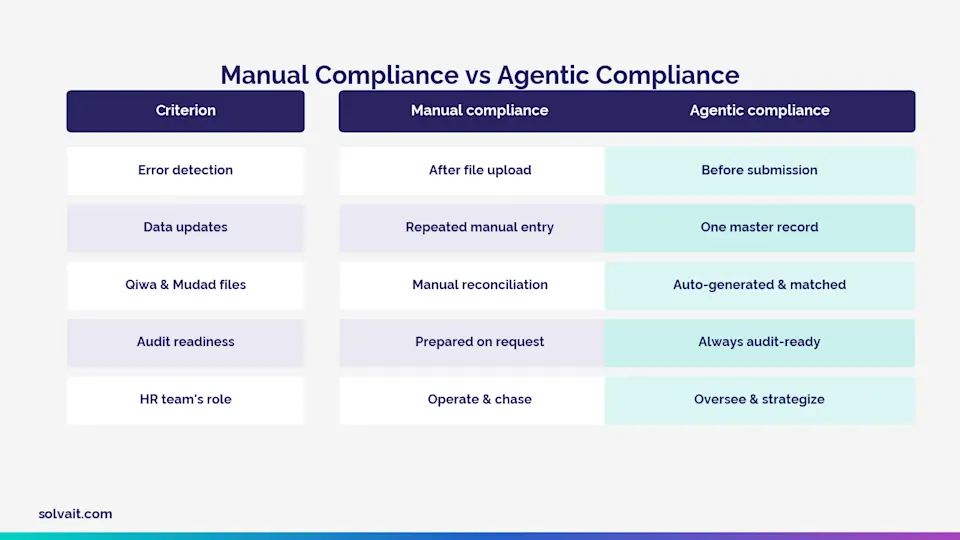
Agentic AI adds a layer of pre-submission validation on top of that record. Before a Mudad file is uploaded, the agent compares payroll data against Qiwa and GOSI records and flags any mismatch, suspicious change, or historical inconsistency. The system doesn't just show you the problem. It proposes the fix and holds the file until it's resolved.
How Agentic compliance differs from ordinary automation
Ordinary automation runs a fixed rule: calculate the contribution, generate the file. Agentic compliance goes further. It plans, verifies and acts within boundaries a human sets. Here is the practical difference in day to day HR operations.
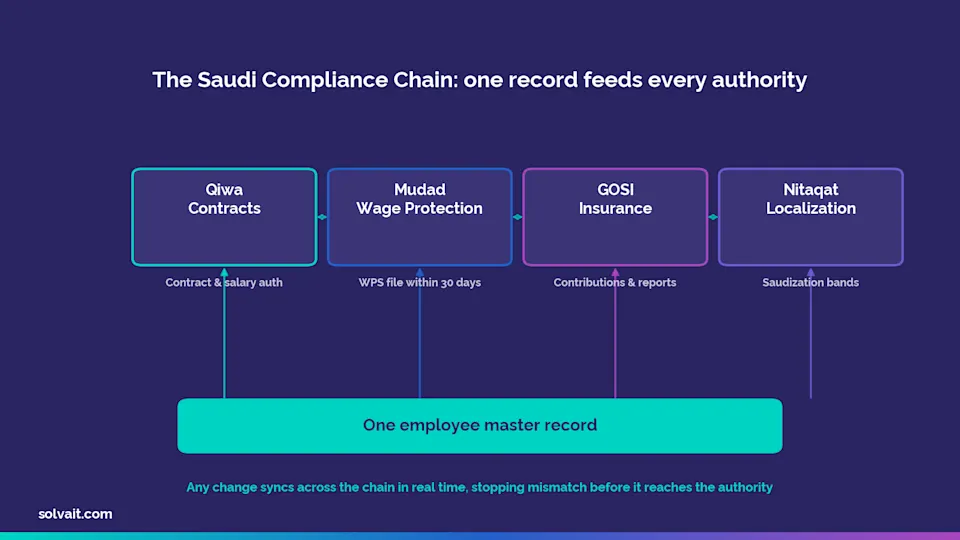
Criterion | Manual compliance | Agentic compliance |
Error detection | After file upload | Before submission to the authority |
Data updates | Repeated manual entry | One master record, cascades automatically |
Qiwa & Mudad files | Manual reconciliation across systems | Auto generated and matched before the window |
Audit readiness | Prepared on request | Always audit-ready, with an audit trail |
HR team's role | Operate and chase | Oversee and make strategic decisions |
Look at the last row. The real difference isn't the files, it's where your team spends its time. When the system handles operating and chasing, the team is free to work on policy and employee experience instead of hunting errors.
The numbers behind the shift to now
AI adoption is no longer a fringe bet. McKinsey reports that 88% of companies use AI in at least one business function, that two thirds of HR processes can be partially or fully automated, and that AI could generate $150 billion to $200 billion in annual value in the HR function alone.
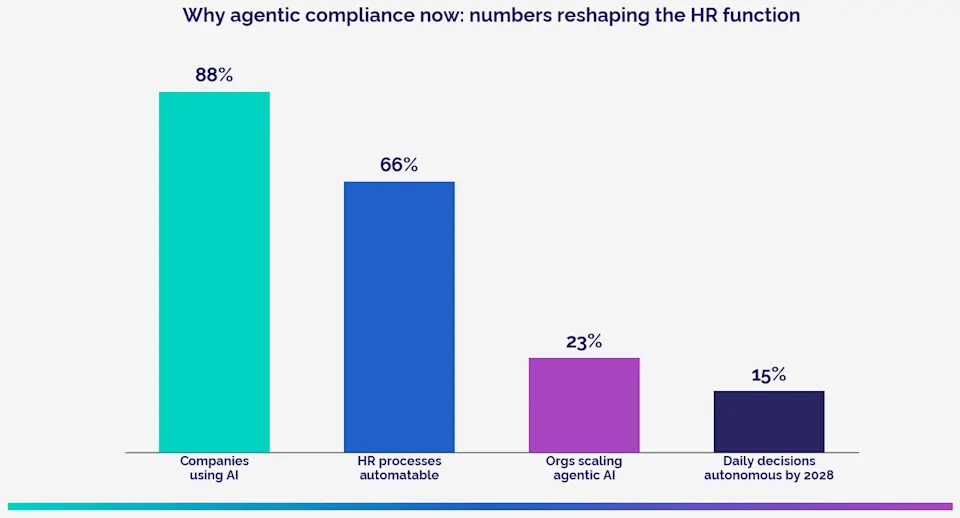
But the current wave moves past automation toward agents. In McKinsey's 2025 survey, 23% of organizations were already scaling an agentic AI system in at least one function. Gartner predicts that 15% of day to day work decisions will be made autonomously by agentic AI by 2028, up from virtually none in 2024. The direction is clear, and the organizations building their architecture now are ahead of the curve.
One honest caveat: agentic AI won't fix bad data. If the employee record is incomplete or contradictory to begin with, the agent will simply automate the mess faster. That's why a successful project starts with cleaning the data and unifying the record, not with the agent. And this is where humans stay in the loop. The agent detects and proposes; the final call stays a human responsibility, especially for classification and salary changes that touch Nitaqat and GOSI directly.
Where humans fit in all this
Fears that agents will replace HR teams are overdone. What actually happens looks more like a redistribution of work. The agent takes the repetitive, high-volume tasks; the human is freed for governance, strategy and the sensitive cases. Deloitte describes this as a "silicon based workforce" working alongside the human one, letting people focus on what needs human judgment.
In the Saudi compliance context, that means a payroll officer shifts from entering and reconciling data by hand to reviewing what the system flagged and deciding on it. Accuracy goes up, operational pressure goes down, and the employee experience improves because pay arrives correct and on time.
How Solvait treats compliance as an operating layer
Solvait is built on Microsoft Dynamics 365 and treats Saudi compliance as an operating layer over a unified employee record, not as separate modules. The Solvait HCM platform connects payroll, GOSI and wage protection in one data structure, so any update flows to the relevant authorities automatically and ahead of the deadlines. Solvait Wise adds the intelligence layer that detects deviations and proposes the fix before a file reaches the authority.
The practical result: errors drop before they happen, audit readiness becomes a constant state rather than a monthly scramble, and your team moves from operating to strategy. If you want to gauge the impact of accuracy on your own payroll first, the free salary calculator is a good starting point.
To see how agentic compliance actually runs on your organization's data, book a Solvait demo.
FAQ
What is agentic AI for HR?
It's a model of automation in which software agents execute HR tasks step by step, such as matching Qiwa data, checking a Mudad file and calculating a GOSI contribution, under human oversight. It differs from ordinary automation in that it anticipates an error and proposes the fix before it happens, rather than only running a fixed rule.
How does agentic compliance reduce payroll errors?
The system compares payroll data against Qiwa and GOSI records before the Mudad file is uploaded, catching mismatches, suspicious changes and historical inconsistencies. Because the check happens before submission to the authority, a potential violation is corrected before it becomes an actual one, which matters far more than fixing it afterward.
What is the current deadline to upload the wage protection file in Mudad?
Since 1 March 2025, the Ministry of Human Resources and Social Development cut the wage protection file window on Mudad from 60 days to 30 days. This makes an accurate, documented and promptly submitted monthly payroll process essential for keeping your compliance rate up.
Does agentic AI replace the HR team?
No. The Agentic AI takes on repetitive, high volume tasks, while humans remain accountable for governance and sensitive decisions such as employee classification and salary changes. The nearer effect is freeing the team from manual operation so it can focus on policy, strategy and employee experience.
How are GOSI contributions calculated in Saudi Arabia?
GOSI contributions are calculated on basic salary plus housing allowance only, capped at SAR 45,000 per month. The rate for a Saudi employee is 18%, split between employer and worker. Transport allowances, bonuses, overtime and end of service gratuities are excluded from the calculation.
References
McKinsey — HR's dual mandate in the AI era, 2026 (backs: 88% use AI, two thirds of HR processes automatable, $150B to $200B value)
McKinsey — The state of AI in 2025, 2025 (backs: 23% scaling an agentic system)
Deloitte — Unleashing agentic AI's true potential, 2025 (backs: Gartner 15% by 2028, silicon based workforce concept)
Ready to see Solvait in action?
Book a personalized demo and see how Solvait's AI-powered HR platform can transform the way your team works.
Tags
Related Posts

GOSI Automation Saudi Arabia: Calculate, File & Audit
Calculate, submit and audit GOSI contributions in Saudi Arabia accurately, without a dedicated compliance specialist, using agentic payroll automation.
Aug 24, 2026
AI Agentic HR: Smarter Hiring in the Gulf
How AI Agentic HR from managing operations to running them: faster hiring, attrition prediction and smart Saudization. A practical guide for Gulf leaders.
Jun 10, 2026
AI Recruitment in Saudi Arabia
How does Agentic AI speed up hiring in Saudi Arabia? CV screening, one skills based match score, and a decision that stays with your team. Meet Solvait Attract.
Jun 8, 2026