
AI Agentic HR: From Managing Operations to Running Them Intelligently
AI Agentic HR are autonomous software units that execute HR tasks and make operational decisions within boundaries a human sets, rather than only analyzing data and offering recommendations. The difference between an AI Agentic and an AI assistant is small but decisive: the assistant waits for a detailed instruction, while the agentic reads the context and then carries out the right action on its own.
This isn't an incremental upgrade in tooling. It's a redefinition of what the HR function does. In the Gulf, and Saudi Arabia and the UAE in particular, the shift is accelerating because it ties directly to Vision 2030, which puts AI at the center of raising the economy's efficiency. For a CHRO or an IT director, understanding this model is no longer optional.
Three stages: from storing data to autonomous execution
HR has evolved through three clear stages :
In the first, systems stored data and ran operations manually.
In the second, AI arrived as an assistant that analyzed data and predicted trends.
The third stage, the one we're in now, introduced the agent, which doesn't stop at analysis but executes the decision within defined limits.
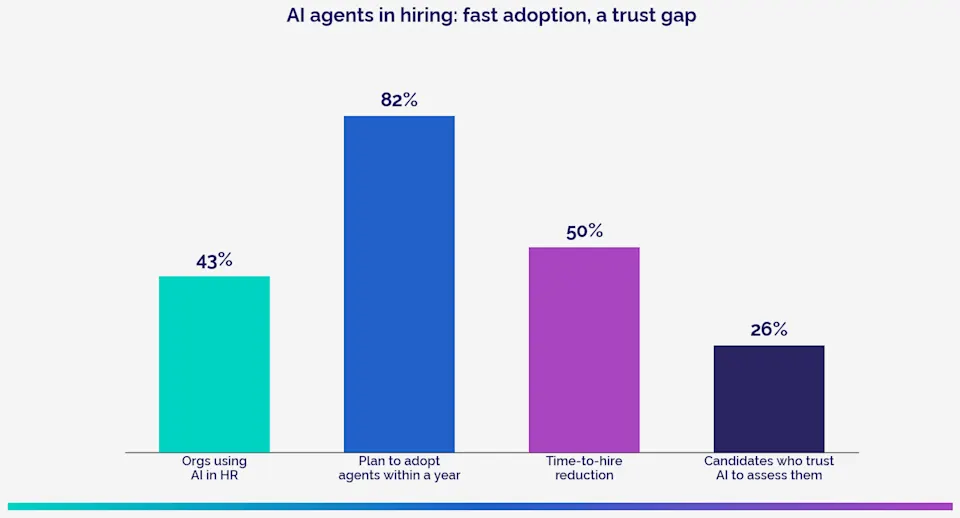
The practical difference is that HR is no longer a chain of manual tasks. It's a network of digital agents working in parallel across the organization. And the numbers confirm the shift is real, not hype. According to SHRM's 2025 Talent Trends report, AI use in HR jumped to 43% from 26% in 2024, with recruiting as the top use case. More tellingly, 82% of HR leaders plan to deploy agentic capabilities within 12 months, per Gartner.
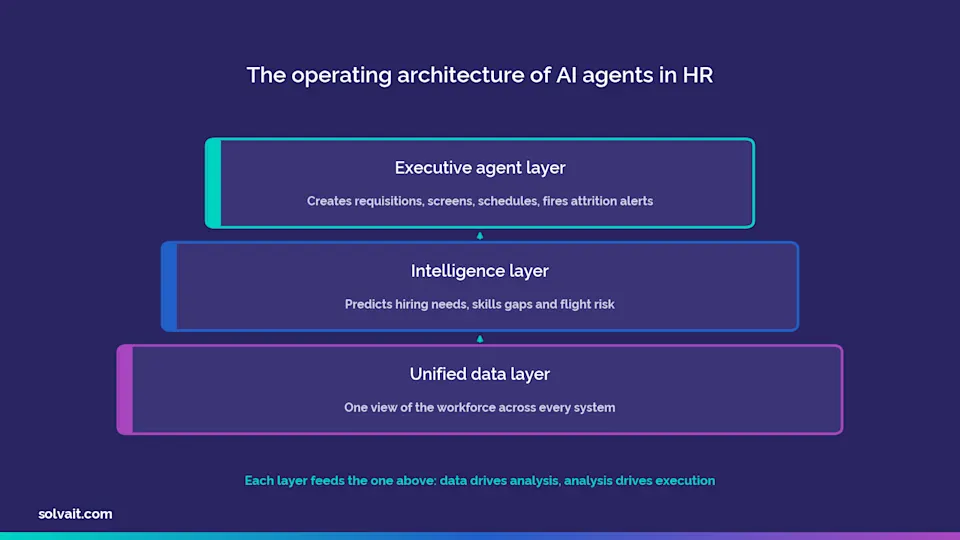
The operating architecture: three layers that feed each other
You can simplify how agents work inside an organization into three stacked layers. The bottom is the unified data layer, where employee, role and process data live in one connected source instead of scattered across separate systems. Above it sits the intelligence layer, which understands future hiring needs, performance patterns and skills gaps, without letting the analysis stay theoretical. The top is the executive agent layer, the heart of the concept: autonomous units that create requisitions, screen candidates, coordinate interviews and fire early alerts when someone is a flight risk.
That last layer is what makes the system "act" rather than just "think." Without it, AI stays an elegant dashboard.
Where the value actually shows up
Theory is one thing; daily practice is another. Here is where decision makers feel the difference.
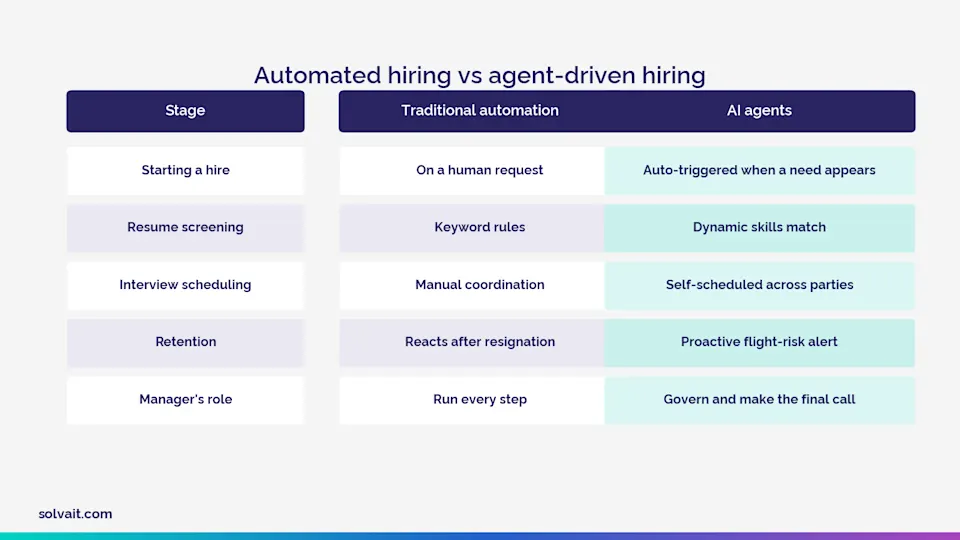
Proactive hiring : In the traditional model, hiring starts with a human request and moves through separate stages. With agents, the flow starts automatically when a role need appears: the system analyzes the need, drafts a job description, sources candidates, and screens resumes against dynamic criteria rather than rigid keywords. The value here is measurable. SHRM reports that AI supported tools raise quality of hire and shorten its timeline, and LinkedIn data shows TA teams using generative AI cut roughly 20% of their weekly workload, about one full workday a week.
Stage | Traditional automation | AI agents |
Starting a hire | On a human request | Auto-triggered when a need appears |
Resume screening | Keyword rules | Dynamic skills match |
Interview scheduling | Manual coordination | Self scheduled across parties |
Retention | Reacts after resignation | Proactive flight risk alert |
Manager's role | Run every step | Govern and make the final call |
Predicting resignations before they happen : Instead of waiting for the resignation letter, the system analyzes attendance patterns, performance shifts, team interaction and career path movement, then proposes an early intervention: a path adjustment, a recommendation to the line manager, or a redistribution of tasks. The goal isn't only fewer resignations, it's keeping the critical talent specifically.
Smart Saudization : In the Saudi market, localization is a strategic challenge, not just an administrative box to tick. Here the agent analyzes localization-rate gaps across departments, suggests roles that fit national talent, links training programs to real demand, and tracks Saudi employees' progress along their path. Saudization shifts from a number in a report to a data driven process.
A balance point: the agent doesn't remove the human
It's easy to let the conversation drift toward full automation, but the data says otherwise. SHRM found that average cost per hire and time to hire both rose over the past three years despite the spread of generative AI, because many organizations bought the tools without redesigning the process. More importantly, only 26% of candidates trust AI to assess them fairly, per Gartner, and 93% of hiring managers consider human involvement essential.
The lesson is clear: the agent excels at repetitive, high volume tasks like screening and scheduling, but the final decision and the sensitive cases stay a human responsibility. The model that works is human agent collaboration, not replacement. And any organization that starts with the agent before cleaning its data and unifying its record will simply automate the mess faster.
How Solvait applies this model
On Microsoft Dynamics 365, Solvait builds an intelligent operating layer that turns HR processes into executive units working within clear boundaries, closing the gap between decision and execution. The Solvait Attract platform handles hiring from need analysis through interview scheduling, and Solvait Wise adds the intelligence layer that detects flight risk and skills gaps and turns them into ready to execute recommendations.
The philosophy behind it: the future isn't in automating HR, it's in making HR capable of decisions while the human stays in the governance seat. If you want a low risk first step to try smart screening on your own roles, start with the free CV match analyzer.
To assess your organization's readiness for AI agents and build a practical plan around your goals, book a Solvait demo.
FAQ
What is the difference between an AI assistant and AI agents in HR?
An AI assistant analyzes data, offers recommendations and waits for a detailed human instruction to execute each step. An agent reads the context and then carries out the right action automatically within pre set permissions, such as creating a requisition, screening candidates or scheduling an interview without waiting for an instruction per task.
Do AI agents replace the recruiting team?
No. Agents take on repetitive, high volume tasks like screening and scheduling, while the final decision and sensitive cases remain a human responsibility. Gartner found 93% of hiring managers consider human involvement essential, and the model that works best is human agent collaboration rather than full replacement.
How do AI agents help with Saudization in the Saudi market?
The agent analyzes localization rate gaps across departments, suggests roles that fit national talent, links training programs to real demand, and tracks Saudi employees' progress along their career path. This turns Saudization from a regulatory obligation into a continuous, data-driven process.
Does AI actually reduce time to hire?
SHRM and LinkedIn data show AI supported tools speed up hiring and raise its quality, and TA teams cut roughly 20% of their weekly workload. But the results depend on implementation quality, not just buying the tool. The organizations that redesigned their process are the ones that captured the biggest gains.
What risks should you watch when adopting agents?
The biggest is starting on unclean data, since the agent will only automate the mess faster. Then there's the trust gap: only 26% of candidates trust AI to assess them, per Gartner, which makes transparency and visible human oversight essential. Governance, data security and system integration are real challenges to address before scaling.
References
SHRM: AI in HR, 2025 Talent Trends, 2025 (backs: 43% adoption vs 26%, recruiting top use case, rising time and cost-per-hire)
Gartner, via industry coverage: AI in recruiting statistics, 2025–2026 (backs: 82% plan agentic capabilities within a year, only 26% trust AI assessment)
McKinsey: HR's dual mandate in the AI era, 2026 (backs: recruiting ~20% of AI value in HR)
Deloitte: Unleashing agentic AI's true potential, 2025 (backs: proactive agents and silicon-based workforce concept)
Ready to see Solvait in action?
Book a personalized demo and see how Solvait's AI-powered HR platform can transform the way your team works.
Tags
Related Posts

Recruiter Burnout in Saudi Arabia: The AI Fix
Recruiter burnout in Saudi Arabia comes from three busywork drains: screening, chasing candidates, and bilingual writing. Here are how AI removes each.
Sep 23, 2026
Agentic AI for HR: Smarter Compliance in Saudi Arabia
How Agentic AI turns Qiwa, Mudad and GOSI compliance from manual tracking into an intelligent layer . A guide for Saudi employers.
Jun 9, 2026
ATS and Time to Fill in Saudi Arabia: Where Time Goes
The global time to fill a role is about 44 days, and most of it is lost screening CVs by hand. See how an ATS reads and ranks resumes in minutes.
Oct 5, 2026