

OKRs That Actually Work: Aligning Every Saudi Team to Vision 2030
OKRs (Objectives and Key Results) are a goal setting framework that connects a company's big ambition to measurable outcomes at the level of every department, team, and person. The Objective answers "what do we want to achieve?" and the Key Results answer "how will we know we're getting there?" Tie those to Vision 2030, and every employee in Riyadh or Jeddah gets a clear line of sight from their daily work to the national priority their company serves.
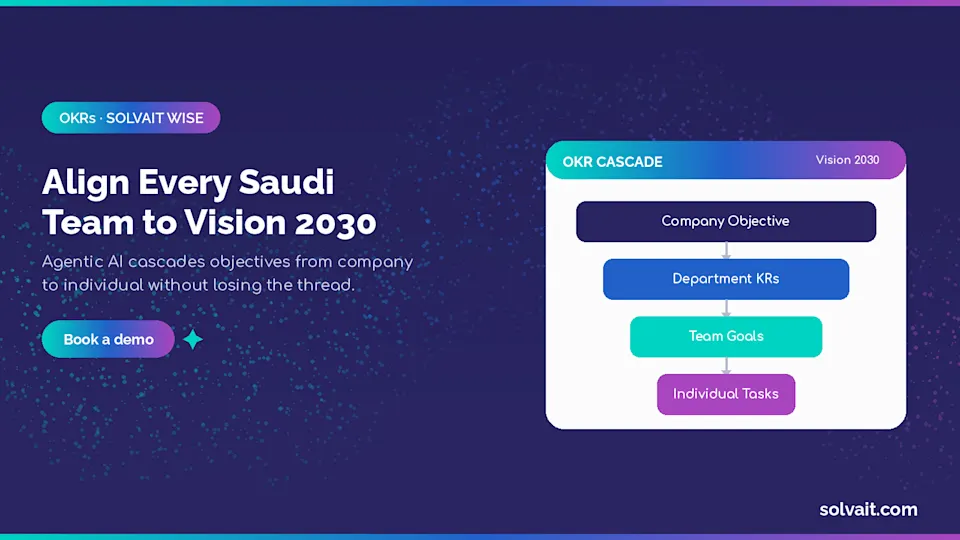
The framework isn't the problem. Execution is. Plenty of companies write beautiful goals in January and forget them by March. The goals become a document in a folder instead of a weekly compass. This post covers three things: why most goals never move the numbers, how to write goals that genuinely align to Vision 2030, and how agentic AI cascades those goals top to bottom without the alignment breaking along the way.
Why most performance goals never move the business ?
One number sums up the problem. 65% of teams say their OKRs are not directly linked to company goals, according to a 2025 global benchmark of more than 200 companies. When two thirds of your goals float free, poor results shouldn't surprise anyone.
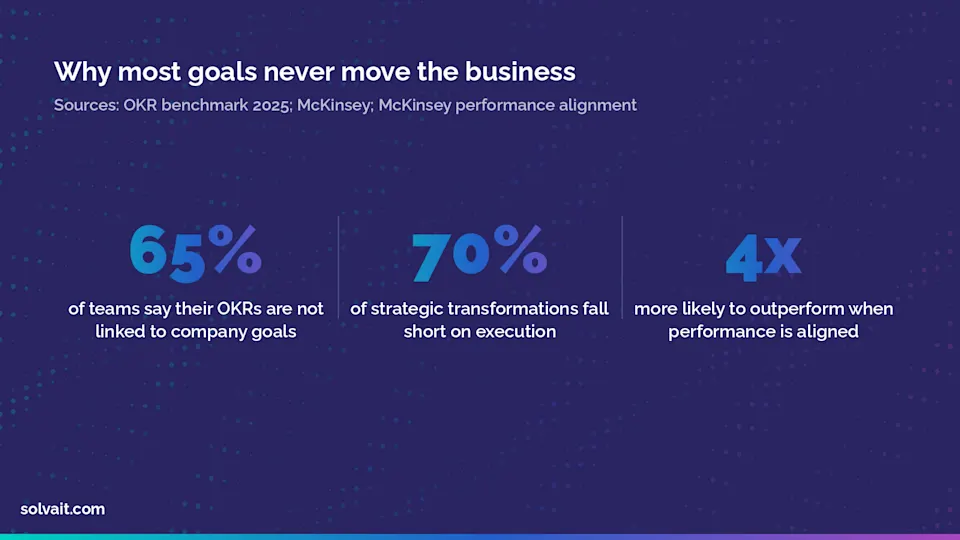
The rest of the picture fills in fast. McKinsey estimates that 70% of strategic transformations fall short at the execution stage, not the planning stage. And organizations that focus on performance alignment are four times more likely to outperform their peers. The gap between the two groups isn't the intelligence of leadership. It's whether employee number 240 knows how their work serves a goal they understand and believe in.
This is where the Saudi market has its own weight. Labor force participation reached 68.2% in Q1 2025, with Saudi participation climbing to 51.3%, per the Ministry of Human Resources and Social Development. That means entire new teams are joining the private sector and need, from day one, a framework that links their effort to company goals. Vague goals cost those teams months of work in the wrong direction.
How to write goals that genuinely align to Vision 2030
Aligning to Vision 2030 doesn't mean pasting national slogans into your goals document. It means choosing outcomes that serve a real priority: localizing skills, raising productivity, expanding women's participation, or digital transformation. Vision 2030 targets roughly 920,000 additional jobs by 2030, and every company contributes to that number in its own way.
The practical rule: link each company level objective to one national priority, then ask each department how it serves that objective with a measurable result. Take a logistics firm in Dammam. Company objective: "raise the share of qualified Saudis in supervisory roles." HR key result: "increase Saudis in supervision from 30% to 45% this year." Recruiting team key result: "hire 12 qualified Saudi supervisors before the end of Q3." Each result has a number, a link upward, and a named owner.
Quality comes from disciplined writing. Teams that cap their objectives at three per cycle, with three to four key results each, hold their focus. Drowning an employee in ten goals kills the priority. And a practical note from Google: the ideal achievement range for a goal is around 70%, because consistently hitting 100% means your targets weren't ambitious enough.
How agentic AI cascades goals from top to bottom
Here's the part everyone stumbles over by hand. Drafting a full cascade from a company objective down to hundreds of employees eats two to three weeks of HR and manager meetings. And after every shift in priorities, the whole thing starts over.
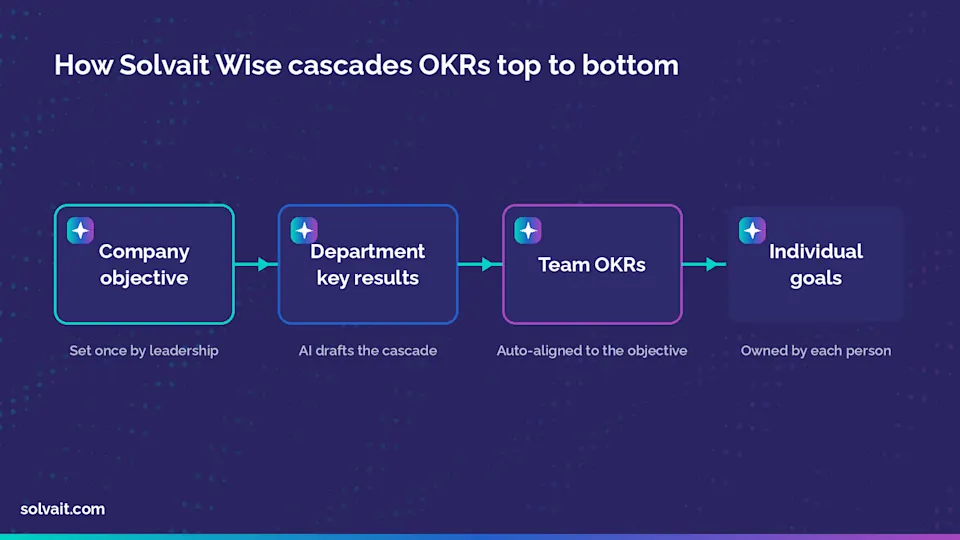
Agentic AI flips the equation. Leadership sets the objective once, then the agent drafts the cascade: it proposes key results for each department derived from the company objective, then team OKRs, then individual goals. Every level is auto aligned to the one above it and stays editable by the manager. The agent doesn't replace the manager's judgment. It hands them the first draft and makes sure the alignment chain never breaks.
The difference shows up in the numbers. Organizations that connect individual and departmental goals to company objectives see far stronger alignment and execution. And in a 2025 global benchmark of over 200 companies, those combining OKRs with strong execution routines outperformed peers financially and in growth by more than 22%.
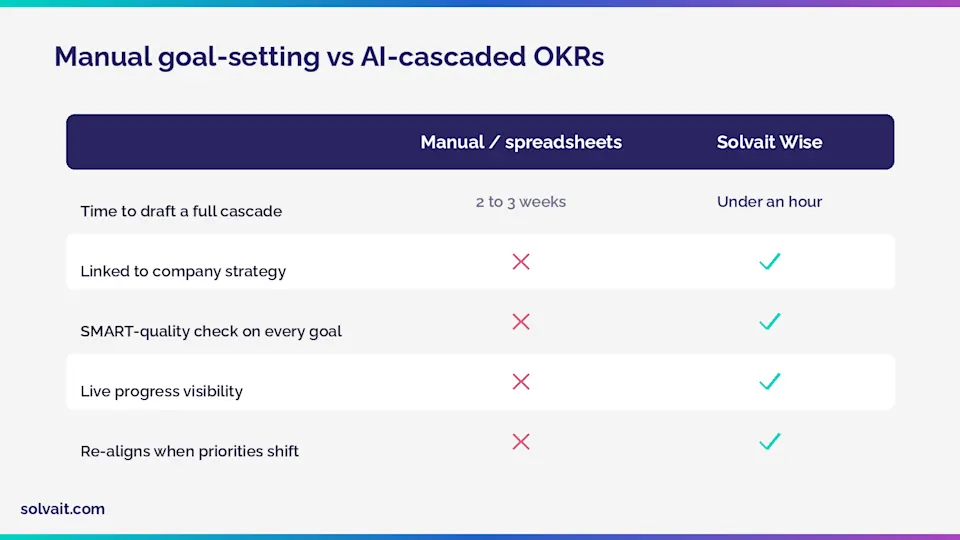
This is where Solvait Wise comes in, the AI performance and talent platform built on agentic AI. It generates OKRs and cascades them from company to department to individual, checks each goal against SMART criteria, and shows progress live. When priorities change, it re proposes the alignment instead of starting from zero. Solvait Wise doesn't replace your HR system. It empowers it with a performance intelligence layer.
Start with the free Appraisal Goal Generator to see how AI writes measurable goals in seconds. When you're ready to see the full company to individual cascade, book a Solvait Wise demo.
FAQ
What's the difference between OKRs and KPIs?
A KPI measures the health of an ongoing process, such as employee turnover. An OKR is a framework for setting an ambitious goal over a fixed period with key results that measure progress toward it. In practice, a KPI tells you how a process is doing today; an OKR drives the change you want to make this quarter or year.
How do you tie OKRs to Vision 2030?
Link each company level objective to one national priority, such as Saudization, productivity, or digital transformation, then ask each department for a measurable result that serves it. The key is a numbered result with a named owner, not a general slogan.
How many OKRs should a team have?
Best practice is to focus on no more than three objectives per cycle, with three to four key results each. Piling on more scatters focus and kills the prioritization the whole framework depends on.
Does Agentic AI replace the manager's role in setting goals?
No. Agentic AI provides the first draft of the cascade and guarantees alignment and writing quality, but the manager still decides what to edit and approve. The agent is decision support, not a substitute for management judgment.
References
OKR benchmark 2025: Business Strategy Trends 2025: OKRs Help You Better Execute, 2025 (65% alignment gap; 22% outperformance)
McKinsey & Company: via Celoxis: OKRs & Project Management, 2025 (70% of transformations fall short at execution; alignment raises goal attainment)
McKinsey performance alignment: OKR Mentors, 2025 (4x more likely to outperform when aligned)
Ministry of Human Resources and Social Development: Progress in the Saudi Labor Market, 2025 (68.2% participation; 51.3% Saudi)
Konrad-Adenauer-Stiftung: High-Skilled Employment and Vision 2030, 2025 (~920,000 additional jobs by 2030)
Google / What Matters: via People Managing People: Performance Management Statistics, 2026 (ideal OKR achievement ~70%)
Ready to see Solvait in action?
Book a personalized demo and see how Solvait's AI-powered HR platform can transform the way your team works.
Tags
Related Posts
Future of HR in the GCC: 5 Predictions for 2027
Five practical predictions for the future of HR in the GCC by 2027, backed by Gartner, PwC , and what agentic AI means for Saudi and Gulf teams.
Aug 11, 2026
Appraisal Goals: How to Write Ones Your Team Believes
Why most appraisal goals fail to motivate, and how to write believable SMART goals in Saudi Arabia, with the role of AI in drafting them fast.
Jul 12, 2026
How to Choose an AI HR System in Saudi Arabia
A buyer's checklist of 7 questions that expose the real difference between AI HR systems in Saudi Arabia, before you sign the contract.
Oct 8, 2026