

From Automation to Agentic AI: Payroll Error Detection That Actually Prevents Mistakes
Agentic AI is an operating approach in which Agentic AI monitor payroll data, verify it against policy and history, and take early action under human oversight, instead of just executing predefined rules. That single difference separates companies that discover payroll errors after payday from companies that stop them before the run.
The numbers make the case bluntly. According to EY's 2022 payroll study, one in five payrolls contains errors, and each one costs an average of $291 to fix. The payroll engine itself is rarely the culprit. It calculates flawed inputs flawlessly, because verification happens once at month end instead of running all month.
This guide covers where payroll errors actually originate, what they cost beyond the corrected amount, why traditional automation hits a structural ceiling, and how agentic AI changes the equation for payroll and finance teams in Saudi Arabia and the wider Gulf.
Why payroll errors persist despite modern systems
It's tempting to assume that buying the newest payroll software closes the file. It doesn't. The system executes whatever reaches it, and if what reaches it is a housing allowance nobody updated or a wrong start date, it will process both with impressive speed and a wrong result.
EY's study quantifies how deep this runs inside mid-size and large organizations:
The average organization makes 15 corrections per payroll cycle.
Time, attendance, and expense errors are the most frequent, occurring more than once per employee per year.
Fixing just the five most time-consuming error types consumes nearly 29 workweeks per year for every 1,000 employees.
Manual handling compounds the problem. In Deloitte's Global Payroll Benchmarking Survey, 30% of organizations named manually entering payroll inputs and manual adjustments among the most time consuming parts of processing. Every manual transfer between the attendance system, the HR system, and finance adds a weak point, and every weak point becomes another month end adjustment.
Here's the part most teams get wrong: the error almost never starts at calculation. It starts weeks earlier. A missing field in an employee file. A promotion approved in one system that never reached another. Unpaid leave logged late. The final payslip is simply a mirror of the data quality accumulated over the month.
The real cost: trust before money
Your employees never see the process chain behind their pay. They see one number land in their account, and they judge the whole organization by it.
And they judge harshly. The Workforce Institute found that 49% of employees start looking for a new job after just two payroll errors, still the most cited benchmark on the subject. Fresher data confirms the pattern: in HiBob's 2025 survey, 53% of employees said they would consider leaving if payroll mistakes continued, and 64% reported real financial stress caused by a pay error or delay.
Then comes the replacement bill. Gallup estimates the cost of replacing one employee at one half to two times their annual salary. Add the HR and finance hours burned on corrections, plus compliance exposure under Saudi Arabia's Wage Protection System, Mudad, and GOSI filings, and the "small" error in an attendance sheet becomes a genuine line on the operational risk register.
Scale multiplies everything. A problem you contain with one phone call at 50 employees becomes a full weekly workload at 5,000.
Why automation alone stopped being enough
Traditional automation served companies well for years. It moved calculations out of Excel into structured payroll software, shortened the cycle, and killed most copy paste errors. But it carries a structural limit no extra rule can fix: automation executes instructions and never questions the data. If the rule says "calculate the allowance from field X," it will, even when field X contradicts the employee's contract.
Agentic AI works from a different angle. Agentic AI for HR monitor the data continuously, reconcile sources against each other, flag abnormal patterns, and raise an alert or propose an action before the data enters calculation. Humans keep the final decision, but they face early signals instead of late surprises.
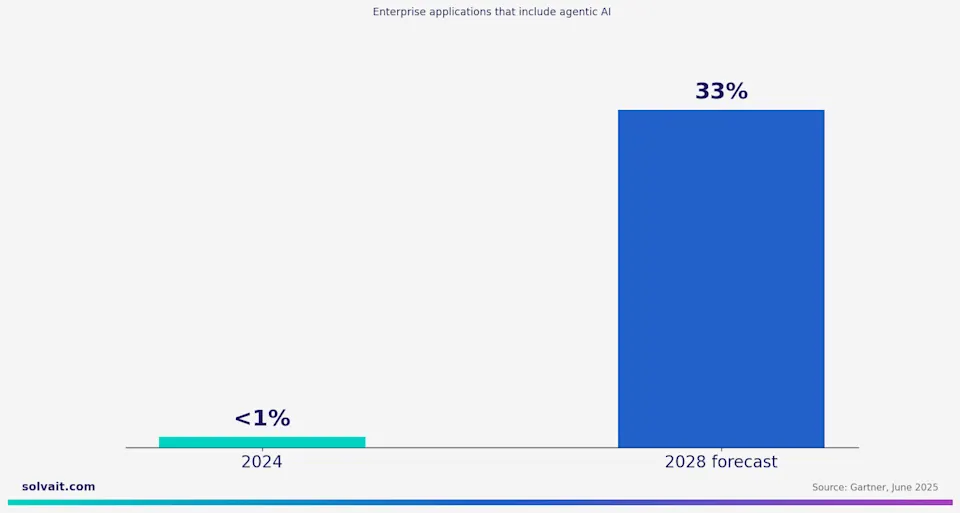
The shift is no longer theoretical. Gartner predicts that 33% of enterprise software applications will include agentic AI by 2028, up from less than 1% in 2024, and that at least 15% of day-to-day work decisions will be made autonomously through it by the same date.
One honest caveat before we go on. Agentic AI won't fix a vague allowance policy, won't compensate for the absence of a clear data owner, and it does require upfront investment in unifying your sources. What it changes is one decisive thing: when you find out about the problem.
Traditional automation vs agentic AI
Criterion | Traditional automation | Agentic AI |
How it works | Executes predefined rules | Reads context, takes proactive action |
When errors surface | After the payroll run, often via complaints | Before calculation and approval |
Data quality | Assumes inputs are correct | Verifies inputs continuously |
Handling change | Rules updated manually | Detects the change, assesses its impact |
Payroll team's role | Fixes and reviews after the fact | Decisions on early alerts |
The takeaway is blunt: both execute the process, but one finds the problem after it reaches the employee and the other intercepts it first.
How agentic verification runs inside the payroll cycle
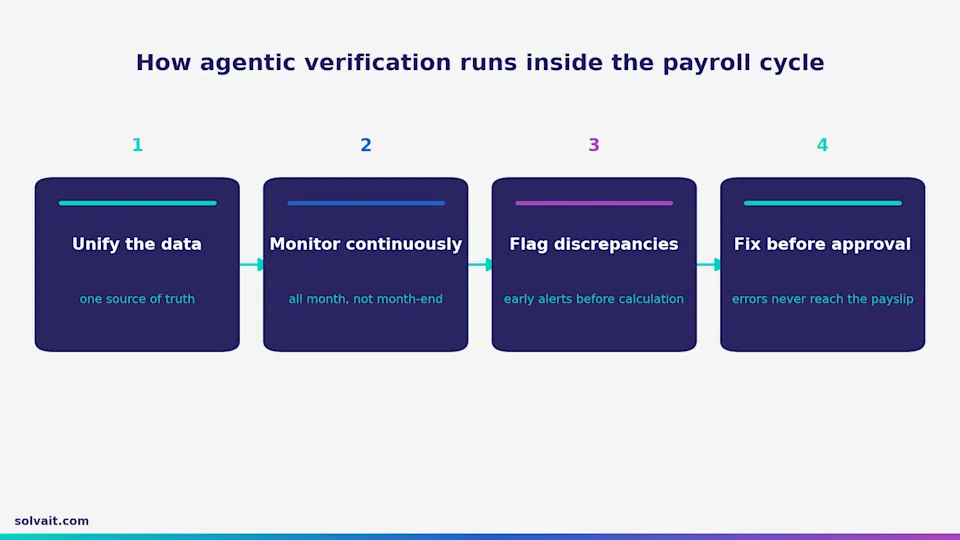
In practice, an agentic payroll setup runs through four connected stages:
Unify the data.
Employee records, attendance, allowances, and leave live in one source of truth. Skip this and the agent spends its life comparing conflicting versions of reality.
Monitor continuously.
The agent tracks changes as they happen throughout the month: a promotion, an internal transfer, an allowance edit, exceptional leave.
Flag discrepancies.
Every change gets checked against company policy, the employee's history, and normal patterns. A housing allowance that jumps past its grade band raises an alert immediately.
Fix before approval.
The alert reaches payroll or finance with full context, the decision gets made, and the data is corrected before the run, not after it.
The result compounds. Every cycle with fewer errors builds employee trust and frees the team from recurring corrections toward higher value work like workforce cost analysis and planning.
Mistakes most teams make when improving payroll
We've watched these patterns repeat across companies of every size, and they deserve naming:
Automating bad data.
Moving a mess from Excel into a modern system gives you a faster mess, not more accurate pay. Clean the sources first.
Verifying only at month end.
A review on approval night finds errors after the calm window for fixing them has closed. Verification is a month long process.
Measuring speed, ignoring accuracy.
A payroll run finished in two days that generates ten later adjustments is not a win. Track adjustments per cycle the way you track cycle time; most mature organizations treat payroll accuracy as a standing KPI.
Ignoring historical data until end of service.
End of service benefits under Saudi labor law are calculated across years of records, and any accumulated error surfaces all at once at the most sensitive possible moment. A quick periodic check with the
exposes gaps before they become disputes.
How Solvait puts this approach to work
Solvait builds the payroll stack on Solvait HCM, running on Microsoft Dynamics 365, where employee, attendance, allowance, and leave data live in one source instead of scattered systems. On top of that foundation sits proactive verification: continuous monitoring of changes, early discrepancy detection, and alerts that reach the payroll team before approval, with full readiness for Saudi WPS and GOSI requirements.
If you want a zero-commitment first step, try Solvait's free salary calculator to sanity-check pay and deduction figures instead of trusting breakable manual formulas.
Reaching zero errors doesn't mean nothing changes inside your organization. It means you catch the change before it becomes a mistake in someone's pay. The more connected your data and the smarter your verification, the closer you get, in measurable steps.
Want to see what that looks like on your own data? Book a demo with the Solvait team.
FAQ
What is agentic AI in payroll management?
Agentic AI in payroll is a system that continuously monitors employee, attendance, and allowance data, detects discrepancies and abnormal patterns, and raises alerts or proposes actions before payroll is calculated and approved, while the final decision stays with the payroll team. The goal is preventing an error before it reaches the employee rather than correcting it after payday.
What tools can help improve the accuracy of payroll calculations?
The biggest gains come from a unified HCM platform that keeps employee, attendance, and allowance data in one source, direct integrations that remove manual re entry, and an agentic AI layer that verifies inputs continuously against policy and history. Free utilities such as salary and end of service calculators help teams spot check figures quickly before formal approval.
How do AI agents improve payroll accuracy and reduce manual errors?
AI agents reconcile data across systems in real time, compare every change against company policy and the employee's history, and flag anomalies before the payroll run. That removes the two biggest error sources: manual data transfer between systems and month end only reviews. Humans still approve, but they act on early alerts instead of post payday complaints.
Will agentic AI replace the payroll team?
No. The agent takes over monitoring, reconciliation, and anomaly detection, which consume hours without adding strategic value, while accepting or rejecting alerts, judging exceptions, and setting policy remain human work. The outcome is a team with less firefighting and more focus, not necessarily a smaller one.
References
EY — Cost and Risks Due to Payroll Errors, 2022 (share of payrolls with errors, $291 per error, 15 corrections per cycle, 29 workweeks per 1,000 employees; the most recent edition of this study)
Gartner — Gartner Predicts Over 40% of Agentic AI Projects Will Be Canceled by End of 2027, 2025 (33% of enterprise applications and 15% of daily decisions by 2028)
Deloitte — Global Payroll Benchmarking Survey, 2024 (30% cite manual inputs and adjustments as most time-consuming)
The Workforce Institute at UKG — Just two payroll errors can cause 49% of employees to start job hunting, 2017 (the 49% benchmark, still the most cited figure on payroll errors and retention)
HiBob — Beyond the Paystub: Why Payroll Accuracy Is the Bedrock of Employee Experience, 2025 (53% would consider leaving if mistakes continue, 64% experienced financial stress)
Ready to see Solvait in action?
Book a personalized demo and see how Solvait's AI-powered HR platform can transform the way your team works.
Tags
Related Posts

Solvait HCM Goes Live Across Almutlaq Group
Solvait HCM is now live at Almutlaq Real Estate (AREIC), Qantara Development, and Almutlaq Furniture. How one group unified HR on a single platform.
Jun 28, 2026

Sorting CVs using Agentic AI
How Agentic AI cuts hours of work to seconds, and how to make sure you don't lose the right candidate during fast screening in Saudi Arabia?
Jun 24, 2026

Employee Retention AI Tool
How an employee retention AI tool flags flight risk before the notice, and how GCC HR teams turn those signals into a retention strategy that works.
Jun 21, 2026