
WPS in Saudi Arabia: What Most Companies Get Wrong, and Pay For
The Wage Protection System is a Ministry of Human Resources and Social Development programme that ensures private sector employees are paid in full and on time, through electronic bank transfers whose data is uploaded monthly to the Mudad platform and matched against GOSI records and Qiwa contracts.
What catches teams out isn't the rule. It's that the rule produces a single number called your compliance rate, and that number connects directly to your services in Qiwa and to your Nitaqat classification. Which means a mistake in a payroll file can surface later as a blocked visa rather than as an email from finance.
This piece covers how the monthly cycle actually runs, five recurring mistakes we see in payroll teams, and how pre payroll validation stops most of them from happening at all.
How WPS compliance Saudi Arabia rules work month to month
Five steps, each one a possible failure point:
Prepare payroll: basic wage, allowances and deductions for every employee, Saudi and expatriate.
Transfer through the bank: from an approved account, fully electronic. No cash, no cheques.
Upload the file to Mudad: an electronically sealed wage file covering everyone on the payroll.
Matching: the system compares what was transferred against GOSI records and Qiwa contracts, then updates your compliance rate.
Justify any flag: where a shortfall, delay or contract mismatch is detected, the employer submits a justification that reaches the employee in their own account, and their response determines what happens to your rate.
Step five is the most neglected. Plenty of teams assume a flag expires on its own. It doesn't. It stays active and drags the rate down until the case is closed.
Five recurring mistakes, and what actually happens
The mistake | What the team assumes | What actually happens |
Paying 80% now and the rest a week later | A minor, understandable delay | A violation raised on the unpaid portion |
Leaving one employee off the file | Nobody will notice | A gap appears when the file is matched against GOSI |
A transferred salary that differs from the documented Qiwa contract | An internal adjustment, fixed later | A mismatch between the contract and the actual transfer |
Skipping the justification step | It expires after a month | It stays active and keeps pulling the rate down |
Reviewing the compliance rate once a year | Enough for an audit | The rate updates with every file, so drops surface late |
Notice the pattern. Four of these five are reasonable operational decisions inside a payroll department. The problem is that they get evaluated in another system, under different logic.
The mistake that starts two weeks before payroll
Most wage protection violations aren't born on upload day. They're born earlier, in incomplete data nobody flagged: a bank account not updated after the employee switched banks, an expired ID or iqama, a contract not yet documented for a recent joiner, a pay component keyed manually at a figure the contract doesn't carry.
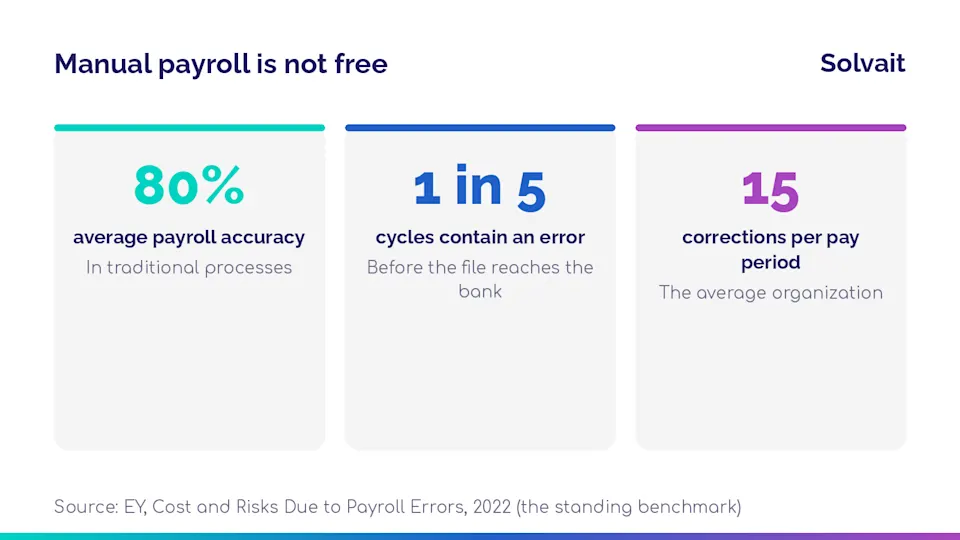
The standing benchmark here is still EY's study on the cost and risks of payroll errors: average payroll accuracy in organizations running traditional processes sits around 80%, one in five payroll cycles contains an error, and the average organization makes roughly 15 corrections per pay period. The figures are American and date from 2022, and they remain the reference point for the scale of the problem. The same logic applies to any team running payroll on spreadsheets with one human review before submission.
This is where agentic AI belongs in payroll. The agent doesn't calculate payroll for you. It inspects employee files before the cycle starts: who's missing a bank account, whose ID expired, whose contract isn't documented, which pay component looks anomalous against that employee's own history. The check takes minutes. The error it prevents would have cost a violation, a compliance rate, and possibly a visa.
Four moves before your next payroll run
1. Make pre payroll validation an official step: A fixed checklist executed five working days before disbursement: bank accounts, valid documents, documented contracts, pay components matching the contract.
2. Match three sources, not two: The payroll file, GOSI records, and Qiwa contracts. Stopping at two is what leaves the gap that surfaces later.
3. Close flags in the week they appear: Assign a named owner for justifications rather than "the payroll team".
4. Track the compliance rate monthly alongside your KPIs: Put it next to payroll cost in the monthly report, because it's an operating indicator rather than an administrative footnote.
Where Solvait fits
Solvait HCM runs on Microsoft Dynamics 365 and keeps employee, contract and wage data in a single record, which is the precondition for any clean match. The AI employee profile validation module surfaces the missing bank account, the expired ID or iqama, the contract gaps and anomalous salary components before the file is uploaded rather than after.
Before any of that, try the free salary calculator to break any Saudi salary into basic pay, allowances, GOSI deductions and net in 30 seconds. No signup, no data captured.
To see a full payroll cycle with pre payroll validation inside one system, book a Solvait demo .
FAQ
What is the Wage Protection System in Saudi Arabia?
A programme run by the Ministry of Human Resources and Social Development requiring private sector employers to pay wages through electronic bank transfer and upload a monthly wage file to Mudad. The data is matched against GOSI records and Qiwa contracts, producing a compliance rate tied to the company's government services.
How is the compliance rate calculated?
It updates after every file upload, based on matching the wages actually transferred against the registered data for each employee. Any shortfall, delay or contract mismatch is recorded as a violation that lowers the rate until a justification is submitted and accepted by the employee.
What tools can help improve the accuracy of payroll calculations?
A payroll system connected to employee and contract data in a single source, with automated pre payroll validation that surfaces missing fields and anomalous values, plus reconciliation against GOSI and Qiwa before the file is uploaded. Manual spreadsheets usually fail at one point: keeping data in sync across systems.
What is the effect of WPS violations on a company?
Accumulated violations lead to ministry penalties and can extend to suspension of the establishment's services in the labour ecosystem, which affects visa issuance and work permit renewals. Check Mudad and Qiwa for your current status.
Does WPS cover every establishment?
Yes. The system covers private sector establishments of all sizes following the completion of its phased rollout. Verify your establishment's current requirements through the Mudad platform.
References
Ministry of Human Resources and Social Development: Wage protection file upload service , 2026 (programme definition and upload mechanism)
Mudad platform: Compliance system and wage protection , 2026 (file upload, compliance rate, violation justification)
Qiwa platform: Contract documentation and establishment services , 2026 (linking the contract to the transferred wage)
EY: Cost and Risks Due to Payroll Errors , 2022 (80% accuracy, error in one of five cycles, 15 corrections per period)
McKinsey & Company: The state of AI in 2025 , 2025 (spread of AI agents across enterprise operations)
Ready to see Solvait in action?
Book a personalized demo and see how Solvait's AI-powered HR platform can transform the way your team works.
Tags
Related Posts
Saudi Labour Law Automation: 9 Clauses to Enforce
Nine Saudi labour law clauses your HR system should enforce automatically after the 2025 reforms, from probation caps to WPS files.
Aug 30, 2026

Free Saudi Salary Calculator
Free Saudi salary calculator. Work out gross, GOSI, end of service, and net pay in 30 seconds.
Jun 20, 2026

AI Payroll Error Detection: Catch Gaps Before You Post
How AI payroll error detection flags pay discrepancies before posting by comparing expected vs found and holding the wrong line.
Oct 11, 2026