

From Free Tool to Full Agentic HR: How 3 Companies Made the Move
Agentic HR is an approach to human resources management in which AI agents independently execute complete HR processes, from CV screening to payroll checks, under human oversight. A free tool does one step of that picture. An agentic platform runs the whole picture. The difference between the two is exactly what three Saudi companies discovered when they started with a free calculator, hit its ceiling, then moved to the full platform.
This is their story. Names are withheld at the customers' request, but the numbers and the steps are real.
Why the journey always starts with a free tool
Most HR teams in Saudi Arabia don't begin their AI journey with a board decision. They begin with a small, annoying problem: a tricky end-of-service benefit to calculate, a job description that needs writing fast, a net salary to estimate before an offer goes out. Someone searches for a free tool online, tries it, and it works. That small moment is where everything starts.
And the market pushes hard in this direction. AI adoption across the GCC jumped from 62% in 2023 to 84% in 2025, according to McKinsey's State of AI in the GCC research. In Saudi Arabia specifically, 69% of employees reported using AI tools in their jobs over the past year, per PwC's Middle East Workforce Hopes and Fears Survey 2025. The free tool isn't an exception. It's the door everyone walks through.
But here's where the real problem shows up.
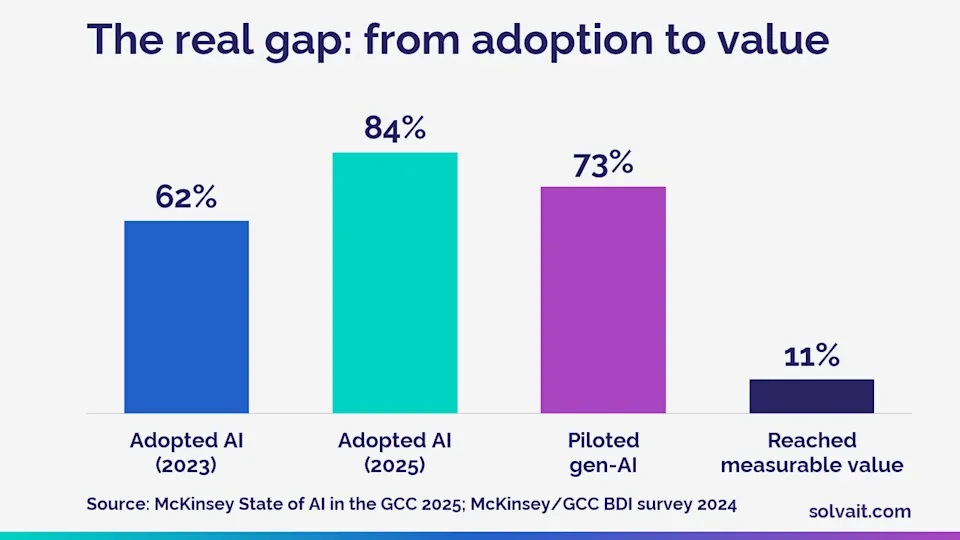
73% of GCC organizations piloted generative AI applications, yet only 11% reached measurable, quantifiable value, according to the McKinsey and GCC Board Directors Institute survey. The gap between those last two bars is the whole story. Adoption is easy. The free tool is easy. Turning it into a real operational result is what separates companies that win with AI from companies that collect scattered tools that never talk to each other.
The three companies below crossed that gap. Here's how.
Company one: from a salary calculator to full payroll
A logistics firm in Dammam with around 600 employees. It started with Solvait's free salary calculator, used by an HR coordinator to estimate net pay before every new job offer.
The problem wasn't the calculator. The problem was what happened after it. The number got copied by hand into a spreadsheet, then re-entered into a WPS file, then manually matched against GOSI records. Three separate steps, three chances for error. With 600 employees, the monthly payroll run stretched into three full days of work, with recurring mistakes on Saudization days and leave balances.
Here's a truth anyone who's worked in HR knows: teams spend as much as 57% of their time on repetitive administrative tasks, according to Deloitte research. The free calculator saved one step. It left every other step manual.
Moving to the full HR system changed the equation. The employee record became one thing: salary, transport allowance, GOSI, WPS, all tied to a single data source. An AI agent checks every payroll run before approval and flags anomalous deductions and mismatches with attendance automatically.
The result the customer shared: the monthly payroll run dropped from three days to a few hours. The free tool was the right start. But it was one step in a ten step process.
Company two: from a job description generator to full recruiting
A fast growing retail company in Riyadh, opening new branches every month and hiring constantly. It started with the free job description generator to write consistent JDs quickly, instead of copying old ones and editing them.
The generator did its job well. But a job description is the first step in a long journey. After it comes posting the ad, receiving hundreds of CVs, screening them, scheduling interviews, following up with candidates. All those steps stayed manual. With more than 300 CVs per role, the team spent weeks on screening alone, often losing good candidates because replies came late.
AI has its biggest impact in recruiting specifically. Around 65% of HR teams use AI in some part of the hiring process, according to Gartner research, the highest usage rate of any HR function. The reason is simple: recruiting is full of repetitive steps that eat time without adding human judgment.
Moving to the full recruiting platform connected every step into one pipeline. The JD that used to be written in the free tool became a launch point inside the system. An AI agent screens CVs against the role requirements, ranks candidates, suggests interview slots, and sends replies automatically. The human team focuses on the final decision, which is exactly where human judgment belongs.
The free JD tool wasn't abandoned. It became the first step in a full process instead of an isolated island.
Company three: from an appraisal goal generator to AI performance management
A services organization in Jeddah with around 400 employees. It started with the free appraisal goal generator, used by a manager to write clear goals for her team ahead of the annual review cycle.
The tool solved the goal writing problem. But it didn't solve a bigger one: what happens to goals after they're written? In most companies, goals get written at the start of the year, saved in a file, then nobody opens them until the next review. No tracking, no updates, no link between an employee's daily work and the written goals. The result is annual reviews built on the memory of the last few months only.
This is where the difference shows between a tool that writes goals and a platform that manages them. Moving to the AI performance platform turned goals from a static document into a living system. Goals are tied to measurable indicators, an AI agent tracks progress through the year, alerts managers when a goal stalls, and gathers real performance data instead of relying on memory.
The impact wasn't just on the review. When an employee sees their goals being tracked seriously all year, their behavior changes. And retaining top performers gets easier when they feel their contribution is visible and valued.
The common thread: where the tool stops, and the platform begins
The three stories are different, but they tell the same pattern. The free tool solves a point problem beautifully. But it's an island. Data goes in by hand and comes out by hand, connected to nothing else. When volume grows, that isolation turns from a minor annoyance into a real bottleneck.
The table below sums up the difference all three companies lived through.
Dimension | Free tool | Agentic platform |
Scope | One task | Full employee lifecycle |
Data | Siloed, copy pasted | One employee record |
Compliance | Out of scope | GOSI, WPS, Nitaqat built in |
AI agents | None | Execute processes end to end |
Measurement | Nothing tracked | Live dashboards and KPIs |
Look at the compliance row. The free tool knows nothing about GOSI, the Wage Protection System, or Nitaqat and Saudization requirements. In the Saudi market, that's not a nice to have. It's a baseline requirement. The full platform builds compliance into the core of every process, which no point tool can offer.
What you should take from these three journeys
The most important point isn't that free tools are bad. They aren't. Solvait's free tools, from the salary calculator to the JD generator, are designed to be a correct starting point. The point is that the free tool reveals the size of the bigger problem you'd been living with.
When you find yourself copying the free tool's result into a spreadsheet, then into another system, then matching it by hand, you've hit the tool's ceiling. That moment isn't a failure. It's a sign of maturity. It means your volume has outgrown point solutions, and it's time to move to a platform that runs the whole process instead of one step of it.
And the move isn't a leap into the dark. None of the three companies started from scratch. Each started from a tool it knew and trusted, then expanded it into a full system. The data they'd collected and the processes they'd understood all came with them.
The AI agents in the Solvait Wise platform don't replace your team. They execute the repetitive work that drains its time. Screening CVs, checking payroll, tracking goals: these are tasks the agents run under human oversight, while your team focuses on decisions that need real human judgment.
If your company relies on one or more free tools today, you're already at the start of the road. The only question is when you'll hit the tool's ceiling, and whether you'll be ready when you do.
Try the right start: Begin with Solvait's free tools today, from the salary calculator to the goal generator, and see for yourself where a point tool stops.
Your next step: When your company hits the ceiling of free tools, book a demo to see what full agentic HR looks like in your own environment.
FAQ
What is the difference between a free tool and agentic HR?
A free tool runs one task, like calculating a salary or writing a job description, then stops. Agentic HR is a full system where AI agents execute connected processes end to end, with a unified data record, built-in compliance, and human oversight on important decisions.
Does my company lose its data when moving from a free tool to a full platform?
No. The move isn't a start from scratch. The data and processes you built around the free tool come with you to the full platform. The three companies in this article expanded what they had instead of replacing it, keeping what they knew and adding the rest of the process.
How do you know your company has outgrown the free tool?
The clearest sign is that you're copying the tool's result by hand into another system, repeatedly. When that manual step becomes a daily bottleneck, or causes recurring payroll or compliance errors, you've hit the point tool's ceiling and it's time for the full platform.
Does agentic AI replace the HR team?
No. Agents execute repetitive work like CV screening, payroll checks, and goal tracking, under human oversight. The final decision stays with your team, while their time is freed from administrative tasks to focus on what needs real human judgment.
References
McKinsey: State of AI in the GCC 2025, 2025 (supports the 62% and 84% adoption figures)
McKinsey & GCC Board Directors Institute: The state of AI in GCC countries, 2024 (supports the 73% and 11% figures)
PwC Middle East: Workforce Hopes and Fears Survey 2025 , 2025 (supports the 69% Saudi usage figure)
Deloitte: Modernizing HR, 2024 (supports the 57% administrative-time figure)
Gartner: HR Technology and AI adoption, 2025 (supports the 65% recruiting-AI usage figure)
Ready to see Solvait in action?
Book a personalized demo and see how Solvait's AI-powered HR platform can transform the way your team works.
Tags
Related Posts
AI in HR: How It Actually Works in the Saudi Market
How AI in HR moves from automation to AI agents in Saudi Arabia, by the numbers, plus where the free digital business card fits into the wider shift.
Aug 17, 2026
When AI Stops Answering and Acts
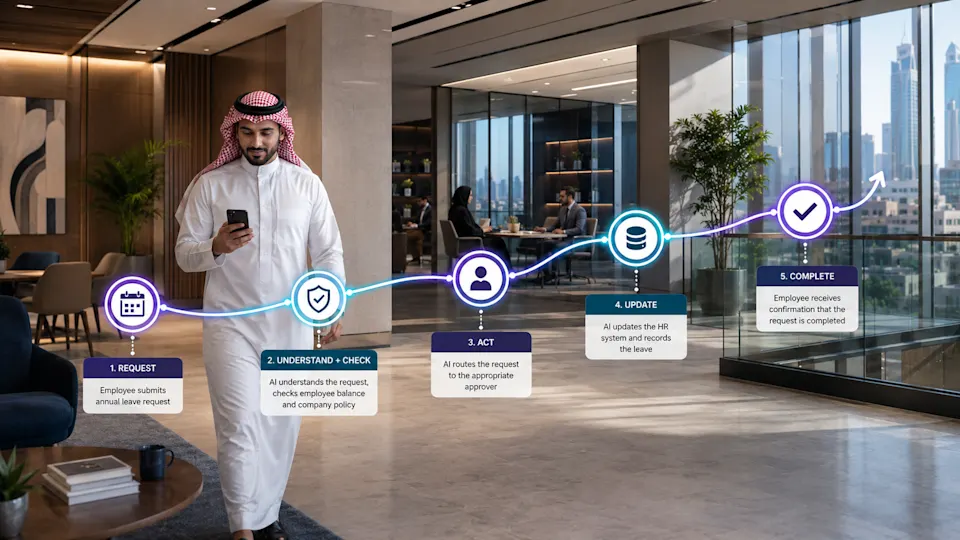
The difference between HR AI that answers employee questions and agentic AI that completes the request end to end under human oversight, with the numbers.
Aug 18, 2026

How Agentic AI Eliminates HR Team Burdens
How agentic AI is reshaping HR team size in Saudi Arabia and the GCC. What agents take over, what humans keep, and the ROI behind a leaner HR team.
Aug 2, 2026