
The 8-Person HR Team Is Dead. Long Live the 3-Person HR Team.
The short version: agentic AI is an approach to human resources in which AI agents independently execute whole HR processes, from pre payroll profile validation to CV screening, under human oversight. The practical result on the ground is that a team of three can now handle what used to keep eight busy. Not because anyone works longer hours. Because the repeatable work moved to agents, and the humans stayed with what they actually do well: judgement, decisions, and relationships.
This isn't a distant forecast. Saudi companies redesigning their operations around agents are seeing it this year. So here's the question every CHRO and CFO is really asking: if the team gets smaller, who does what exactly? And where does the human stay irreplaceable?
Where an HR team's week actually goes
Before we talk about shrinking anything, look at the real problem. HR teams don't suffer from a shortage of talent. They suffer from talent drowning in work that doesn't need it.
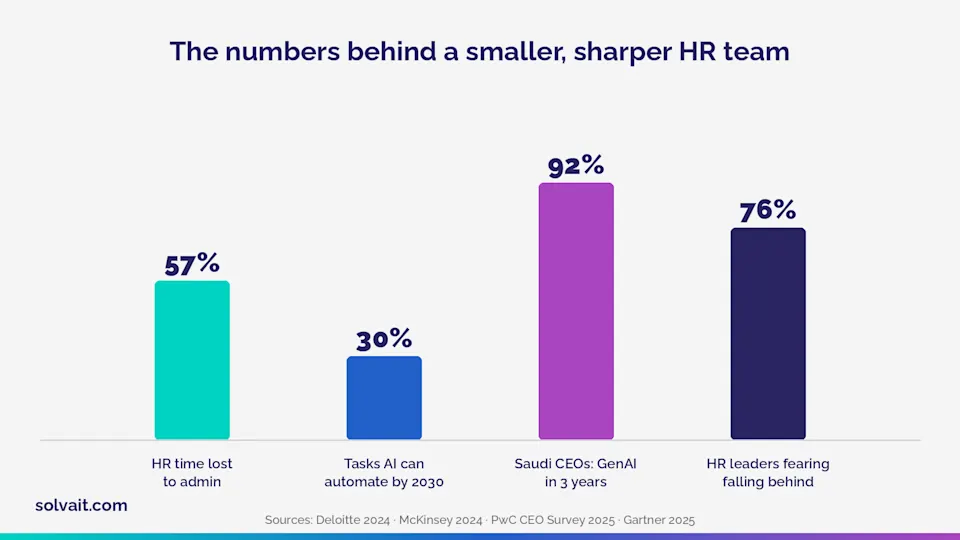
Deloitte found that HR professionals spend up to 57% of their time on administrative tasks: data entry, chasing leave requests, drafting letters, checking payroll files. That's more than half the week going to work that doesn't separate one team from another. Meanwhile McKinsey estimates generative AI may automate up to 30% of business activities across occupations by 2030, with the biggest effect on knowledge work, which is the core of what HR does.
Put those two numbers side by side. Over half the team's time goes to admin, and a third of that admin is about to become automatable. The gap between what your team does and what it should do isn't a talent gap. It's a tooling gap.
What changed: from automation to agents
Old automation did steps. An agent does the whole task.
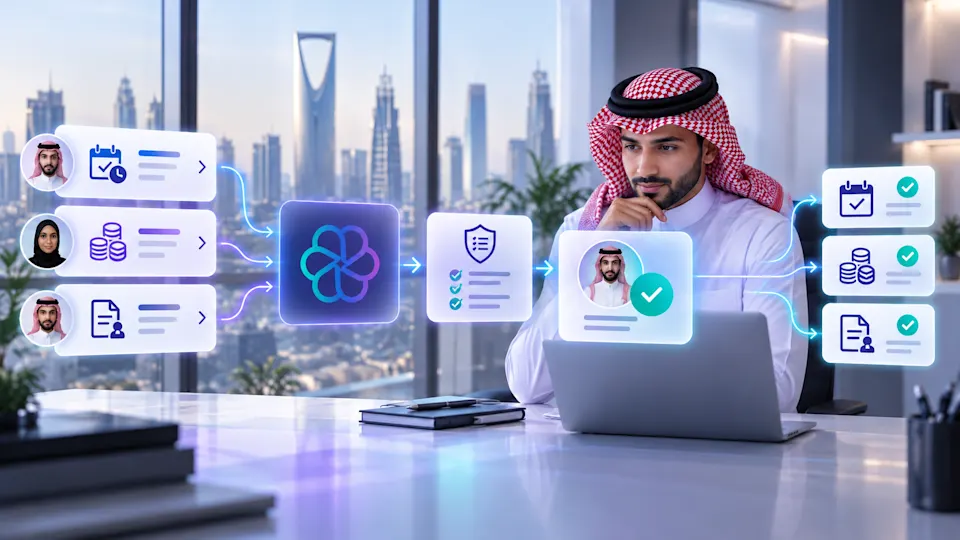
The difference isn't semantic. A legacy system pings you when an Iqama is about to expire. An agent watches the Iqama, confirms the documents are complete, prepares the renewal request, and hands it to the responsible person ready to approve. The first reminds you about the work. The second does the work and leaves you the decision.
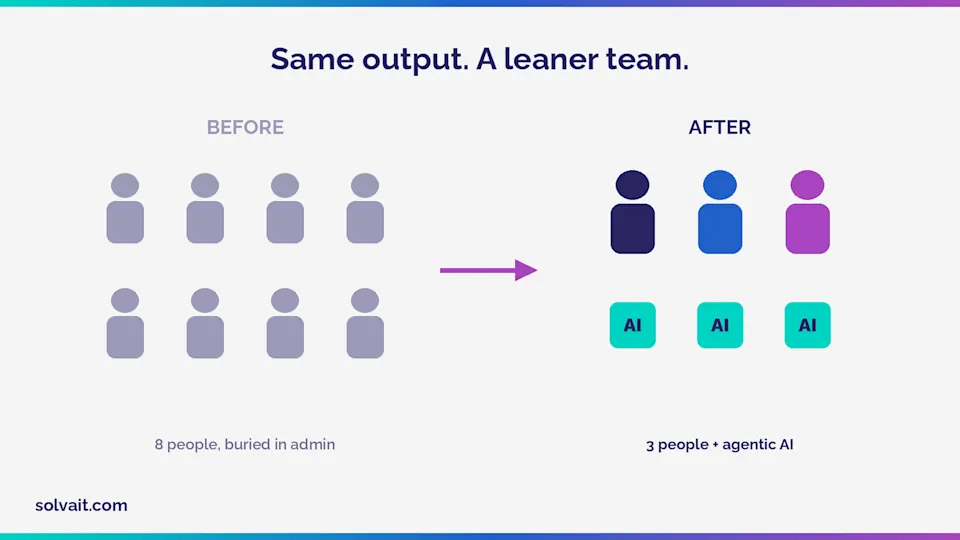
That's the shift. Once the full execution of a task moves to an agent, you don't need a person for every step in the process. You need one person to supervise the agents and step in on exceptions. And that is exactly what takes a team from eight to three.
The region is moving fast enough to make this real, not theoretical. PwC's Middle East Workforce survey for 2025 found 75% of employees in the region used AI tools at work over the past year, and 92% reported productivity gains, both above the global average. The ground is ready. What's missing is the work redesigned around it.
The new team: 3 people + a fleet of agents
So what does a three person HR team look like in practice? None of them spends the day on data entry and follow ups. They're split by judgement, not by tasks.
The first is an HR business partner who sits with department heads and turns business goals into workforce decisions. The second owns operations and compliance, oversees payroll, GOSI, WPS and Saudization, and approves what the agents prepare instead of preparing it by hand. The third owns people and culture, handling the hard conversations, development, and retention. Behind them, a fleet of agents runs without stopping.
Here's the same daily work, run two ways:
Task | Old team (8 people) | New team (3 + agents) |
Pre payroll profile validation | Manual review, line by line | Agent flags gaps and salary anomalies, ready to approve |
Screening CVs for a role | Hours per opening | Agent screens, ranks, surfaces strengths and gaps in seconds |
Repeat employee questions | All land on a human | Chat agent answers most instantly, in two languages |
Compliance tracking (WPS, GOSI, Saudization) | Manual tracking and fear of a fine | Agent monitors continuously and alerts before deadlines |
Hiring and promotion decisions | Human | Human (unchanged) |
Notice the last row. The decision didn't move, and it won't. That's the line.
Where the human stays irreplaceable
The common mistake reading this shift is calling it replacement. It isn't. The agent prepares, the human decides. Confuse the two and you build a fragile team.
Take payroll approval. The agent checks every profile, catches a missing bank account or an anomalous salary, and hands over a clean file. But the final approve button stays with a human, because the legal and ethical accountability is human. Same in hiring: the agent screens fifty CVs in seconds and proposes the best, but who gets hired is a human call that weighs competence, culture, and the things a CV never shows.
And here's a point worth conceding plainly: a good agent won't fix a bad process. If the job description is vague, the agent will just screen candidates for a vague role faster. Automation multiplies the quality of whatever you build on, up or down. The smart teams clean the process first, then hand it to the agent.
That division, between what the agent runs and what the human owns, is the heart of the model:
Why now, and why Saudi Arabia specifically
The timing isn't a coincidence. The Kingdom is one of the fastest AI adopting markets in the world, and Vision 2030 makes digital transformation a national priority rather than an option.
According to GASTAT, AI adoption among Saudi establishments rose to 33.1% in 2025, up from 27.6% in 2024. At the leadership level, PwC's CEO Survey found 92% of CEOs in Saudi Arabia expect generative AI to be integrated into their technology platforms within three years, above the global average. The decision at the top has been made. What separates companies now is who executes first.
The pressure isn't only ambition. It's the fear of falling behind. Gartner reports that 76% of HR leaders believe they'll fall behind competitors if they don't adopt AI within 12 to 24 months, and 38% already use it. Redesign your team today and you build a lead that's hard to close two years from now.
What this looks like with Solvait
At Solvait, agents aren't a bolt on. They're how the platform works. Solvait HCM, built on Microsoft Dynamics 365, runs core HR and WPS/GOSI ready payroll, while a pre payroll agent validates every employee profile before the pay run, catching missing bank details, contract gaps, and salary anomalies before they become an error.
On the performance and talent side, Solvait Wise acts as an agentic layer that reads organizational signals, from span of control to flight risk indicators, and proposes improvements for a human leader to decide on. The model is the same in every product: the agent prepares, the human approves.
Before you rethink your whole team, start small. Try Solvait's free Salary Calculator, no signup and no data captured, to see what an accurate, instant calculation of any Saudi salary looks like.
Then, when you're ready to see the full picture on your own data, book a demo with the Solvait team and let us show you how a three person team backed by agents works inside your company.
FAQ
Does agentic AI mean cutting the HR team?
No. It means redistributing the work. Agents take the repeatable tasks, like payroll validation, CV screening, and answering questions, while a smaller human team focuses on decisions: who gets hired, who gets promoted, and how culture and retention are handled.
How many people does an HR team need with agentic AI?
There's no one size fits all number, but many companies find three human roles, a business partner, an operations and compliance owner, and a people and culture owner, are enough once agents take over the admin work that used to occupy the rest of the team.
What's the difference between traditional automation and agentic AI?
Traditional automation runs a defined step on a defined trigger, like sending an alert. An agent executes a whole task end to end and presents the result ready for human approval, cutting the need for a person to babysit every step manually.
Do agents make decisions like hiring and payroll approval?
No. Decisions carrying legal or ethical accountability stay with a human. The agent prepares, proposes, and catches errors, but payroll approval and hiring and promotion calls stay human, always.
References
McKinsey & Company — The human side of generative AI, 2024 (supports up to 30% of activities automatable by 2030)
PwC Middle East — Workforce Hopes and Fears Survey 2025, 2025 (supports 75% AI use and 92% productivity gains)
General Authority for Statistics (GASTAT) — ICT Access and Usage Survey, 2025 (supports 33.1% adoption among Saudi establishments)
PwC — 28th CEO Survey: Saudi Arabia findings, 2025 (supports 92% of Saudi CEOs)
Ready to see Solvait in action?
Book a personalized demo and see how Solvait's AI-powered HR platform can transform the way your team works.
Tags
Related Posts
Cross Department Coordination: An AI Playbook
How Saudi holding companies coordinate across subsidiaries with agentic AI,and where to start without rebuilding your systems.
Aug 3, 2026
Inside Tashghil: The Operations Agent for HR Automation
Tashghil, Solvait's operations agent, runs leave, advance automatically within guardrails, while your team keeps the call. Here's how.
Sep 22, 2026
Future of HR in the GCC: 5 Predictions for 2027
Five practical predictions for the future of HR in the GCC by 2027, backed by Gartner, PwC , and what agentic AI means for Saudi and Gulf teams.
Aug 11, 2026