
HR AI Trends GCC 2026: A State of Market Report
AI in HR is the use of intelligent systems, from assistants to autonomous agents, to run HR tasks like recruiting, payroll processing, and answering employee questions, under human oversight. In the Gulf specifically, this is no longer a coming trend. It's the current reality. When the major research houses asked HR and business leaders in the region where they actually stand, the picture came out clearer than many expect: the Gulf adopts faster than the global average, but turning that adoption into real value is still the harder job.
This report sums up what the numbers say in 2026, in three parts: where the Gulf stands against the world, where the gap between adoption and impact sits, and what separates the organizations that actually capture value.
Where the Gulf stands against the world
The region isn't a follower in this shift. It's near the front. PwC's Middle East Workforce Hopes and Fears Survey found that 75% of Middle East employees used AI tools in their jobs over the past year, against 54% globally. More telling, 92% of them said AI improved their productivity, well above the global average.
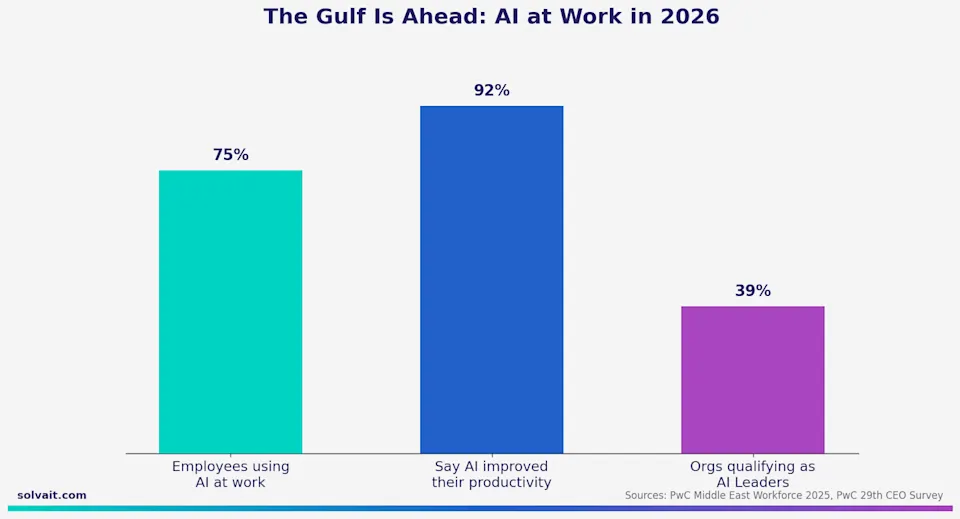
Leadership mirrors the same trend. PwC's 29th CEO Survey, built on more than 300 Middle East chief executives, found that 82% believe their organization's culture supports AI adoption, and 70% have a clearly defined roadmap for AI initiatives. On maturity, a regional report classified 39% of GCC organizations as "AI Leaders," just one point behind the global average of 40%, with 35% of Saudi organizations reaching the "Scaling" stage.
These aren't the numbers of a country catching up. They're the numbers of a market building capability on purpose, in step with Vision 2030 and its investment in digital infrastructure and skills.
The real gap: adoption vs impact
Here's the more important story of 2026. Adoption is wide, but impact hasn't caught up. Gartner's 2025 survey found that 88% of HR leaders say their teams haven't yet seen real business value from AI tools. Across organizations generally, McKinsey's State of AI survey reported that only 23% have begun scaling an agentic AI system, while 39% are still experimenting.
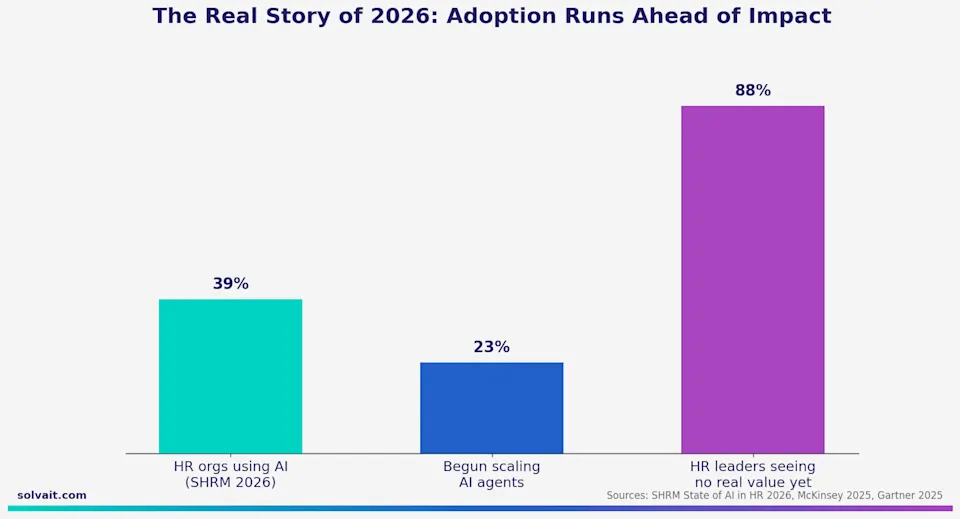
Measure | Figure | Source |
HR orgs using AI | 39% | SHRM, State of AI in HR 2026 |
Begun scaling AI agents | 23% | McKinsey, 2025 |
HR leaders seeing no real value yet | 88% | Gartner, 2025 |
The reason for the gap isn't weak technology. It's how it's used. When an AI tool is bolted on top of an old process without redesigning it, individual productivity rises but the organization's performance stays flat. Mercer's 2026 Global Talent Trends survey found that leadership confidence in being ready for the human machine era fell to 51% in 2026, down from 65% in 2024, despite billions spent. Spending alone doesn't create value.
What separates the value capturers
The difference between those who experiment and those who see impact comes down to one word: redesign. Organizations that capture real value don't add AI on top of what exists. They rebuild the workflow around the agents.
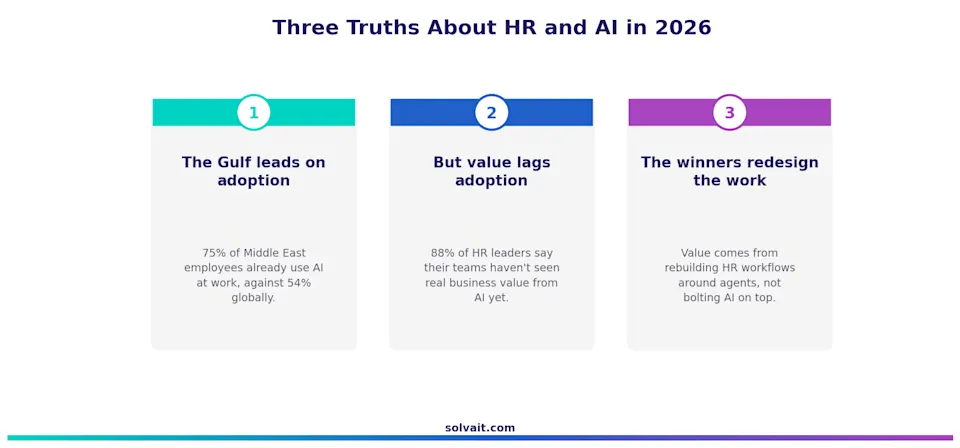
That's what Josh Bersin's research tracks, projecting that 30% or more of traditional HR roles will shift toward higher value work as agents mature. Mercer's survey shows the same direction, with 82% of leaders saying the future of the HR function is managing human talent and digital agents side by side.
In practical terms: an agent doesn't help when you ask it to speed up a broken process. It helps when the process is redesigned around its ability to run a whole task, from spotting the need to proposing the action, under human oversight. The Gulf organizations that started this path early are the ones that will turn their lead in adoption into a lead in results.
Where Solvait fits
This is exactly what Solvait Wise was built for. Instead of adding AI on top of an old system, the agent works inside the workflow itself: it answers employee questions in Arabic and English, monitors the payroll cycle and WPS, and flags compliance gaps before they grow. The team is freed for decisions, and the agent handles operations. Built on Microsoft Dynamics 365, it stays inside an environment your IT team already knows.
The adoption vs impact gap this report tracks doesn't close by buying a tool. It closes by redesigning the work around an agent that reads what's happening and acts. Book a demo to see how Solvait Wise works on your organization's data.
FAQ
What's the state of AI in HR in the Gulf in 2026?
The Gulf adopts AI faster than the global average. 75% of Middle East employees used it in their jobs against 54% globally, and 82% of CEOs say their culture supports adoption. But the bigger challenge is still turning that adoption into real business value.
Why aren't HR teams seeing value from AI despite adopting it?
Because most add the tool on top of an old process without redesigning it, so individual productivity improves while organizational performance stays flat. Gartner reports 88% of HR leaders haven't seen real value yet. Value comes from rebuilding the workflow around the agents, not bolting them onto what exists.
What's the difference between traditional AI and agentic AI in HR?
Traditional AI waits for a command and runs one task. Agentic AI runs a whole process: it spots the need, proposes the action, and executes it under human oversight. In HR, that means an agent handling self service, payroll checks, or compliance end to end.
How do HR teams in Saudi Arabia prepare for this shift?
By starting with one defined scope, redesigning its process around the agent rather than adding a tool on top, then scaling once value is proven. The key is keeping the decision with a human, and redirecting the time AI saves toward higher-value work rather than repeating the same task.
References
PwC: Middle East Workforce Hopes and Fears Survey, 2025 (75% AI use, 92% productivity gain).
PwC: 29th Global CEO Survey, Middle East Findings, 2026 (82% culture support, 70% roadmap).
SHRM: The State of AI in HR 2026, 2025 (39% of HR orgs using AI).
Gartner: HR Leaders AI Value Survey, 2025 (88% seeing no real business value yet).
McKinsey & Company: The State of AI, 2025 (23% scaling agents, 39% experimenting).
Mercer: Global Talent Trends 2026, 2026 (confidence fell to 51%, 82% managing people and agents together).
Ready to see Solvait in action?
Book a personalized demo and see how Solvait's AI-powered HR platform can transform the way your team works.
Tags
Related Posts
How Agentic AI Eliminates HR Team Burdens
How agentic AI is reshaping HR team size in Saudi Arabia and the GCC. What agents take over, what humans keep, and the ROI behind a leaner HR team.
Aug 2, 2026
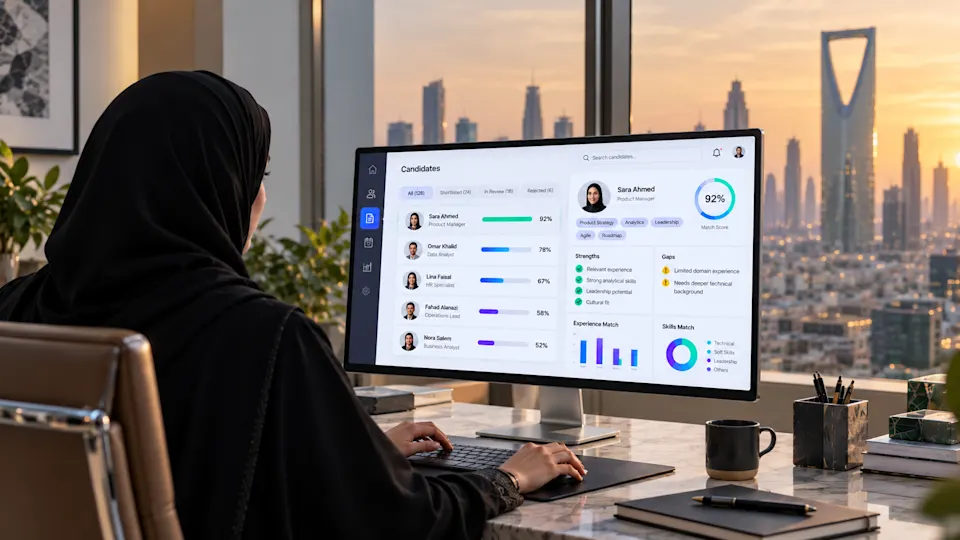
AI CV Screening: How It Ranks Arabic and English CVs
How AI CV screening reads Arabic and English CVs, scores each applicant with strengths and gaps, and what Saudi recruiters should still decide themselves.
Sep 17, 2026
AI in HR: How It Actually Works in the Saudi Market
How AI in HR moves from automation to AI agents in Saudi Arabia, by the numbers, plus where the free digital business card fits into the wider shift.
Aug 17, 2026