

Cross Department Coordination: An AI Playbook for Saudi Holding Companies
Cross department coordination AI is an approach where software agents run whole steps of a coordination process, from spotting the need to proposing the action, under human oversight. In a holding company that means an agent reading what happens across eight subsidiaries at once, catching where their efforts overlap or stall, and proposing the next move before the problem reaches a board meeting. Not another dashboard waiting for someone to open it. A party that works on your behalf between meetings.
The problem it solves isn't abstract. Ask any department head in a Saudi holding group about the last time they discovered two subsidiaries negotiating the same supplier on different terms, or building the same team twice. The answer is usually: too late. This playbook shows how agentic AI closes that gap in practice, across three ideas. Where the real cost hides, how the agent works in four layers, and how to start without rebuilding your systems.
Where coordination cost actually hides
Silos never show up as a line item, which is why they're hard to fix. They surface as extra meetings, duplicated reports, and approval chains built to compensate for alignment that doesn't happen on its own. McKinsey estimates this friction eats 20% to 30% of organizational capacity in siloed companies. In a group running eight subsidiaries, that isn't a percentage on a slide. It's whole manager salaries spent chasing information instead of using it.
And the information moves slowly. McKinsey Global Institute found the average knowledge worker spends close to 20% of the week searching for internal information or tracking down the colleague who has it. That's roughly nine full work weeks a year, per employee, spent looking rather than producing. Multiply that by the managers coordinating across multiple entities and you can see why coordination feels exhausting even when everyone works hard.
Then comes the cost of the late decision. McKinsey links weak cross-functional collaboration to success rates on major initiatives dropping by 15% to 20%. In a holding company, the "major initiative" is often a merger, a shared platform, or a group-wide Saudization plan. Slipping those by weeks isn't an administrative annoyance. It's a real difference in return on a real investment.
Notice what the missing piece isn't. Saudi holding companies own more ERP systems, HR platforms, and dashboards than ever. What they lack is the party that reads all of it together and acts. That's where agentic AI comes in.
How a coordination agent works: four layers
A useful agent isn't a magic box. It's a clear sequence of four layers, each built on the one below it. Drop a layer and everything above it collapses.
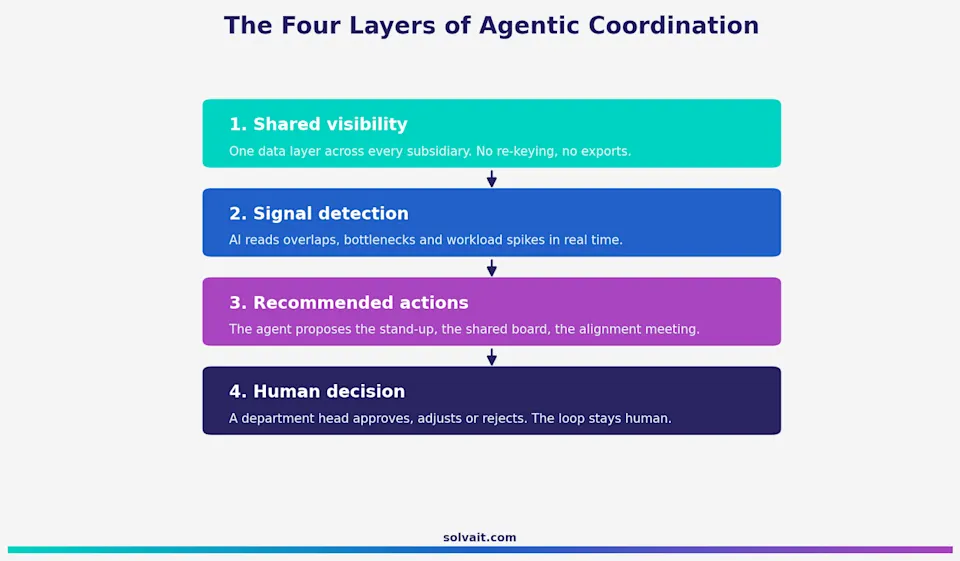
Layer 1: Shared visibility
Before the agent recommends anything, it needs one source of truth. As long as each subsidiary's data sits in its own silo and moves between entities as manually exported spreadsheets, no agent will see the full picture. Layer one pulls org structure, headcount, and hiring plans across every company into a single data layer that's live, not exported. This is the hardest step and the most important. Without it, the three layers above are just a slide deck.
Layer 2: Signal detection
Once the data is unified, the agent reads patterns a person can't, because they're spread across eight systems. Two parallel hires for the same role in different subsidiaries. A manager in one entity supervising 15 direct reports while a peer in another supervises four. A project leaning on a team already loaded with another entity's work. These are the overlap and bottleneck signals, and the agent flags them the day they appear, not in a quarterly review.
Layer 3: Recommended actions
Detection alone changes nothing. The value is the agent proposing a concrete move: a short daily stand-up between two overlapping teams, a shared board that unifies hiring priorities, an alignment meeting before two plans collide. These aren't abstractions. They're proven coordination patterns, suggested in the right context and at the right moment.
Layer 4: Human decision
The last layer is the one that matters most, in the Kingdom and anywhere. The agent proposes, the human decides. A department head approves the recommendation, adjusts it, or rejects it. The loop stays human, not because the technology can't act, but because an organizational decision carries context, relationships, and accountability you don't hand to a machine. This design isn't caution for its own sake. It's what high performers actually do: McKinsey's data shows top performing companies manage AI risk with explicit human in the loop rules.
Where to start without rebuilding everything
The common mistake is waiting for a full transformation. The better move is to start with one layer, in one scope, and expand once the value is proven.
Pick one painful overlap you already know: two subsidiaries hiring for similar roles, or leaning on the same shared team. Unify those two companies' data first (layer one), and let the agent detect and propose for a few weeks before you wire it to any decision. You'll learn fast whether the recommendations hold up in your context, and you build trust before you scale. This incremental path isn't over caution. It's what the companies getting real returns actually do: McKinsey found the gap between firms that experiment with AI and firms that capture financial impact is redesigning the workflow around the agent, not bolting it on top of what already exists.
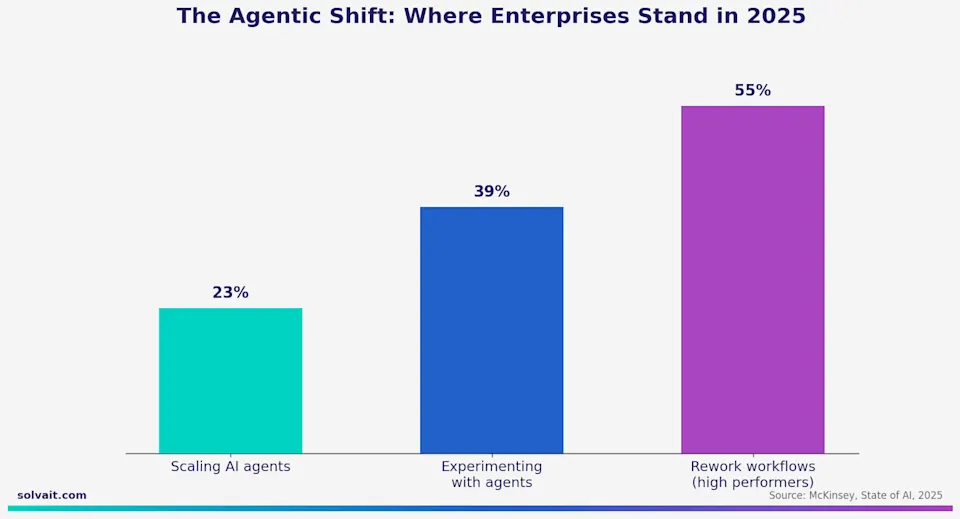
Timing is on your side. Most organizations are still experimenting: only 23% report scaling an agentic AI system in at least one function, against 39% still in the trial phase, per McKinsey's State of AI 2025 survey. The holding company that builds a real coordination capability now gets ahead of a competitor still emailing spreadsheets. The Saudi context sharpens the incentive further. PwC projects AI will add around US$320 billion to GCC economies by 2030, with the Kingdom taking the largest share, which makes building the organizational muscle today an investment in a wave already forming under Vision 2030.
You can also try Solvait's free salary calculator to see how cost data across entities lands in one place, with no signup and no data captured.
Where Solvait fits
This is exactly the job Solvait Wise was built for. It reads org structure across entities, detects supervision loads and bottlenecks, proposes specific optimizations a leader approves or adjusts, then turns them into a prioritized action plan. It doesn't replace your existing HR system. It adds the agentic intelligence layer traditional dashboards lack. Built on Microsoft Dynamics 365, it stays inside an environment your IT team already knows.
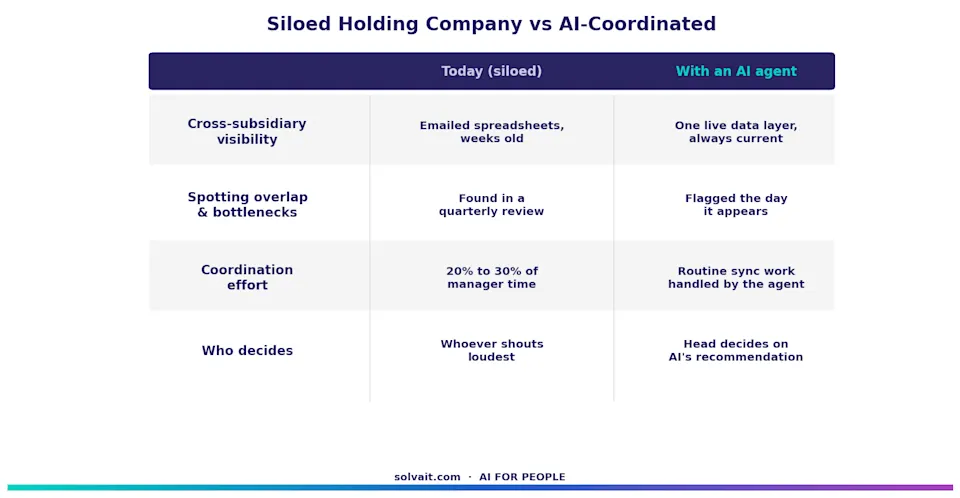
The difference between a holding company that discovers overlap a quarter late and one that catches it the day it appears isn't headcount. It's whether a party reads all the entities together and acts. Book a demo to see how Solvait Wise coordinates across your subsidiaries, on your data.
FAQ
What is agentic AI in cross department coordination?
It's an approach where AI runs whole steps of the coordination process: it detects overlap and bottlenecks across departments or subsidiaries, then proposes a specific action such as an alignment meeting or a shared board, under human oversight. It differs from a dashboard because it initiates the suggestion instead of waiting for someone to read the data.
How does AI help holding companies specifically?
A holding company runs multiple entities on siloed data, so overlap between them is hard to see. The agent reads those entities in a unified data layer and surfaces duplicated hiring, unbalanced supervision loads, and over reliance on a shared team, then proposes coordination steps before the problem grows.
Does the AI make decisions for managers?
No. The agent detects and proposes; the decision stays with the department head, who approves, adjusts, or rejects the recommendation. This human in the loop design is what high performing organizations use to manage risk, according to McKinsey.
How much do departmental silos actually cost?
McKinsey estimates silo friction consumes 20% to 30% of organizational capacity, and the average knowledge worker spends close to 20% of the week searching for internal information. In a holding group, that's whole manager salaries spent coordinating instead of producing.
Do we need to replace our current systems to do this?
No. Effective adoption starts with one scope: a single overlap between two subsidiaries, with just those two unified first. You add the agentic layer on top of your existing systems and expand once the value is proven, rather than rebuilding everything.
References
McKinsey & Company: The State of AI: Agents, Innovation, and Transformation, 2025 (23% scaling and 39% experimenting with AI agents; workflow redesign among high performers).
McKinsey & Company: The Social Economy: Unlocking value and productivity through social technologies, McKinsey Global Institute (roughly 20% of the knowledge worker's week spent searching for information).
McKinsey & Company: research on cross-functional collaboration and silo friction (20% to 30% of capacity; 15% to 20% lower initiative success).
PwC: 28th CEO Survey: Saudi Arabia findings, 2025 (accelerating AI adoption under Vision 2030).
Ready to see Solvait in action?
Book a personalized demo and see how Solvait's AI-powered HR platform can transform the way your team works.
Tags
Related Posts

How Agentic AI Eliminates HR Team Burdens
How agentic AI is reshaping HR team size in Saudi Arabia and the GCC. What agents take over, what humans keep, and the ROI behind a leaner HR team.
Aug 2, 2026

Inside Tashghil: The Operations Agent for HR Automation
Tashghil, Solvait's operations agent, runs leave, advance automatically within guardrails, while your team keeps the call. Here's how.
Sep 22, 2026

Four Agents, One HR Department | Agentic HR
How agentic HR works: four agents (Compliance, Operations, Payroll, Concierge) over a deterministic engine, on Saudi Labor Law rules, from Solvait.
Aug 13, 2026