
The Future of HR in the GCC: 5 Predictions for 2027
Agentic AI is an approach to HR in which software agents independently carry out HR tasks end to end, from CV screening to payroll checks to answering employee questions, under human oversight. That definition is why 2027 feels closer than most HR leaders in Saudi Arabia and the Gulf expect. The question is no longer whether agents reach the HR department. It is which tasks they take first. And in a region where 75% of employees already use AI at work, the shift will arrive before most playbooks do.
Here are five predictions for the future of HR in the GCC by 2027. Each one rests on published figures from Gartner, PwC and the World Economic Forum, not on wishful thinking.
Why the GCC, and why now
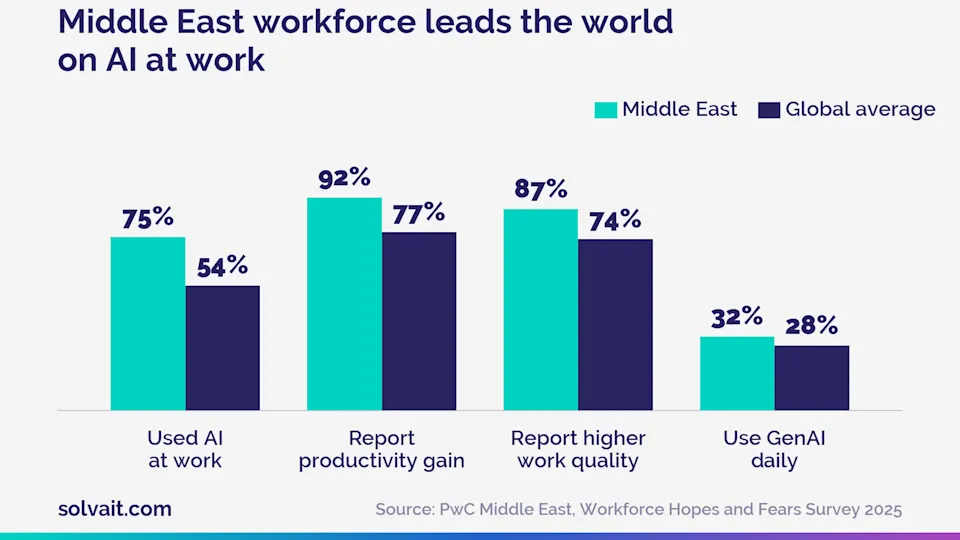
Before the predictions, one number is worth pausing on. PwC Middle East's Workforce Hopes and Fears Survey 2025 found that 75% of the region's employees used AI tools at work over the past year, against 54% globally, and that 92% of them reported a productivity gain versus 77% globally (PwC, 2025). Gulf employees aren't chasing this technology. They're leading it.
Add a local context nobody else has. The Saudi labour market has entered a new phase, with unemployment among Saudi nationals down to 6.4% in Q1 2026 according to GASTAT, and Vision 2030's focus shifting from creating jobs to raising workforce productivity (GASTAT, 2026). When high employee adoption meets national pressure on productivity, HR becomes the first function asked to do more with fewer people. That's where agentic AI enters the picture.
Prediction 1: Agents run the HR back office
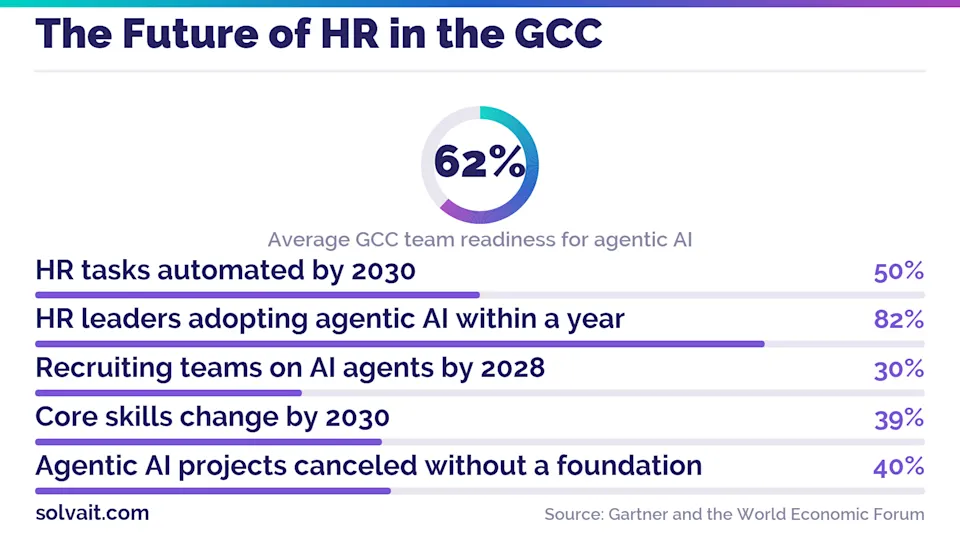
The first thing to change isn't the flashiest, but it runs deepest. High volume repetitive work, from payroll runs to record updates to reporting, moves to agents first. Gartner predicts that 50% of current HR activities will be AI automated or performed by AI agents by 2030, reshaping HR's work and roles (Gartner, 2025).
In the Saudi context, that means an agent validating a Wage Protection System file before it's submitted, reconciling GOSI contributions against the payroll ledger, and flagging an issue before it becomes a fine. The human doesn't disappear. They move from data entry to reviewing the cases the agent surfaces. Anyone waiting until 2027 to start will start behind a competitor who started today.
Prediction 2: The 3 person HR team becomes normal
For years, HR team size was a function of headcount. That equation breaks. Gartner notes that 82% of HR leaders plan to implement some form of agentic AI within twelve months (Gartner, 2025). Once agents run the back office, the department doesn't need more people to do the same work. It needs different people.
The table below sums up the shift as we see it in Gulf companies that started early.
Aspect | HR today | HR in 2027 |
Team shape | 8-person generalist team | 3-person team plus AI agents |
Payroll & compliance | Manual runs, month-end crunch | Agents validate WPS/GOSI continuously |
Hiring | Recruiters screen every CV | Agents shortlist, humans decide |
Employee questions | HR answers each ticket | Bilingual agent handles the routine |
HR's core job | Processing transactions | Judgment, strategy, culture |
Let's be honest about one thing. This doesn't automatically mean cutting people. In many fast growing Gulf teams, it simply means the team stops ballooning as the company grows. The head you were going to hire next year is the head you no longer need.
Prediction 3: Hiring shifts to agent led screening
Recruiting is where agents show their value fastest, because the pain is obvious. Gartner predicts that 30% of recruitment teams will rely on AI agents for high-volume hiring and early-stage tasks by 2028 (Gartner, 2025). An agent reads fifty CVs in the time a recruiter reads one, ranks them by fit to the job description, and explains the strengths and gaps of each candidate.
The common mistake is handing the final decision to the agent. That isn't the goal. Agents shortlist, humans decide. The best Gulf teams use the agent to erase hours of manual screening, then spend the reclaimed time on interviews and human judgment, where the real difference is made. If you want a practical starting point, fix your job descriptions first, because an agent can't rescue a weak one. Try the free job description generator and build the foundation the screening runs on.
Prediction 4: Skills, not headcount, drive workforce plans
When agents take the transactions, the central question in workforce planning changes. It stops being "how many people do we need?" and becomes "which skills do we need, and which are about to go stale?" The World Economic Forum's Future of Jobs Report 2025 estimates that 39% of core job skills will change by 2030, and that 85% of employers put upskilling at the top of their workforce strategy (WEF, 2025).
Across the region, that shift isn't theoretical. You can read it in Saudization moving into a second phase weighted toward productivity and advanced skills over raw quotas, and in the spread of micro credential programmes across the Gulf. HR's role moves from filling vacancies to mapping skills: which capabilities to build in house, which to hire, and which to leave to the agent. That is fully a human job, and no agent does it.
Prediction 5: Governance decides who wins
Here's the prediction that flips the hype. Not every agentic AI initiative will work. Gartner warns that over 40% of agentic AI projects will be canceled by the end of 2027 due to escalating costs, unclear value, and inadequate risk controls (Gartner, 2025). The difference between the teams that succeed and the teams that cancel isn't model quality. It's governance quality.
What does governance mean in practice for Gulf HR? It means defining clearly which decisions an agent makes alone and which it escalates to a human. It means an audit trail for every action that touches a salary or an employee record, because Saudi labour law and the Wage Protection System won't accept a black box. And it means starting from one task with clear value, not ten parallel experiments with no owner. The teams that build this foundation first are the ones that end up in the surviving 60%.
Where agentic AI actually fits in these predictions
All five predictions share one thread: repetitive work moves to agents, and people are freed for judgment, strategy, and culture. That's where a platform like Solvait Wise fits. It's a standalone AI performance and talent management platform that empowers your existing HR system rather than replacing it. Wise links Vision 2030 to team goals through OKRs, reads the org structure to surface bottlenecks, and recommends actions while the decision stays with your leaders.
The foundation matters more than the tool. Whoever builds clear governance and clean data reaps the benefit of all five predictions. Whoever jumps to agents without a foundation risks joining the canceled projects of 2027. If you want to see how these predictions apply to your team specifically, book a Solvait demo and let's map it out step by step.
FAQ
What is agentic AI in HR?
Agentic AI in HR is the use of software agents that independently carry out complete tasks, such as screening CVs, validating payroll files, or answering employee queries, under human oversight. It differs from a traditional assistant because it takes steps and executes actions rather than only responding to questions.
Will AI replace HR teams in the GCC by 2027?
Not likely. Teams are more likely to shrink and change role than disappear. Gartner expects half of HR activities to be automated by 2030, but judgment, strategy, and culture-building stay human. The common Gulf pattern is a team that stops ballooning as the company grows, not mass layoffs.
How does agentic AI comply with Saudi labour law and the Wage Protection System?
It complies when governance comes first. An agent must keep an audit trail for every action touching a salary or employee record, and escalate sensitive cases to human review. The Wage Protection System and GOSI don't accept unexplainable decisions, so transparency is a requirement, not an option.
Where should an HR department start with agentic AI?
Start from one task with clear, measurable value, such as validating a WPS file or screening CVs, not ten parallel experiments. Gartner warns that lack of focus is a leading reason over 40% of projects will be canceled by 2027. One successful task builds the trust and the foundation to scale.
References
Gartner — Gartner Predicts 40% of Agentic AI Projects Will Be Canceled by End of 2027, 2025 (backs Prediction 5 and the 40% figure).
Gartner — Prepare for the Future of AI Agents in HR, 2026 (backs 50% of HR activities automated by 2030 and the 82% figure).
PwC Middle East — Workforce Hopes and Fears Survey 2025, 2025 (backs 75% AI use and 92% productivity gain).
World Economic Forum — Future of Jobs Report 2025, 2025 (backs 39% skills change and 85% upskilling).
General Authority for Statistics (GASTAT) — Saudi labour market Q1 2026, 2026 (backs 6.4% unemployment and Vision 2030 context).
Ready to see Solvait in action?
Book a personalized demo and see how Solvait's AI-powered HR platform can transform the way your team works.
Tags
Related Posts
How to Choose an AI HR System in Saudi Arabia
A buyer's checklist of 7 questions that expose the real difference between AI HR systems in Saudi Arabia, before you sign the contract.
Oct 8, 2026
Solvait Wise 30 Day Action Plan: How It Works
How Solvait Wise turns org structure insight into a practical 30 day action plan: with sourced numbers and clear steps.
Aug 6, 2026
How Agentic AI Eliminates HR Team Burdens
How agentic AI is reshaping HR team size in Saudi Arabia and the GCC. What agents take over, what humans keep, and the ROI behind a leaner HR team.
Aug 2, 2026