

Stop Writing Appraisal Goals That No One Believes In
Believable appraisal goals are ones the employee understands, can track their own progress on, and feels are actually theirs rather than handed down from above. Any goal missing one of those three becomes a line in a form everyone signs and no one believes. The difference between the two kinds isn't polished language. It's a clear number, a fixed date, and a named owner.
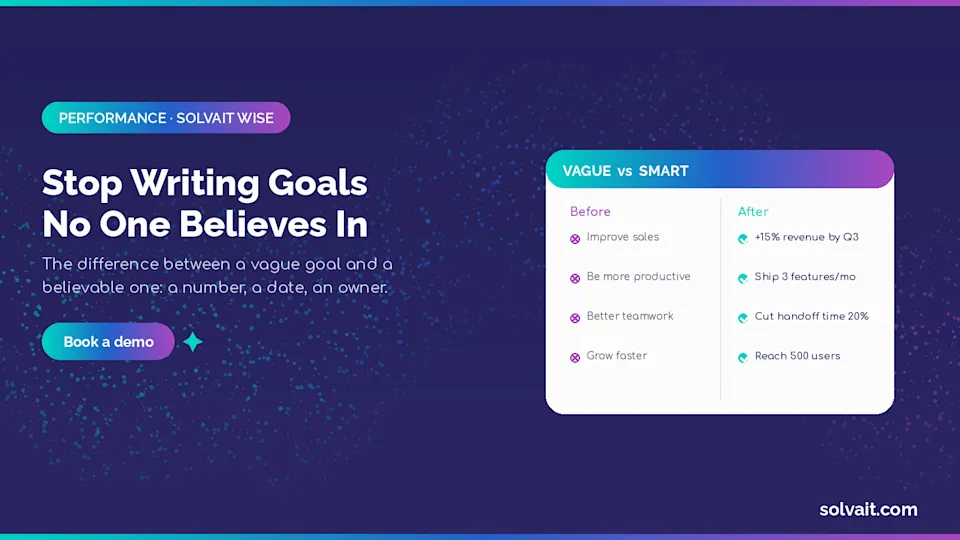
Let's be honest: most corporate appraisal cycles are an annual ritual both sides dread. The manager writes vague goals at the last minute, the employee signs and forgets them. This post covers three things: why appraisal systems lost their credibility, how to turn a vague goal into a SMART one your team believes, and how AI helps draft better goals in seconds.
Why appraisals lost their credibility
Here's the number that should wake up every HR leader. Only 2% of Fortune 500 CHROs strongly agree that their performance management system inspires employees to improve, according to a Gallup survey. When a system loses the trust of the people running it, it's no wonder it loses the trust of the people subjected to it.
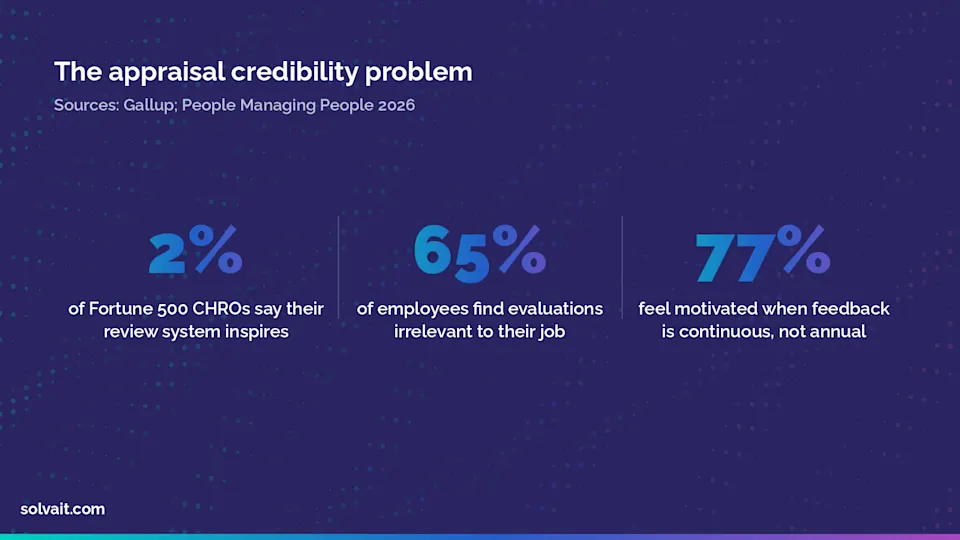
The rest of the picture is bleak. 65% of employees find their evaluations irrelevant to their actual jobs. 95% of managers dislike performance reviews and question their impact. On the other side, 77% of employees feel motivated when they get continuous feedback instead of an annual review. The message is clear. The problem isn't the idea of appraisal. It's vague goals written once a year and forgotten.
The effect reaches retention. Organizations with effective recognition programs are 31% less likely to see voluntary turnover. When an employee sees a clear goal that measures their real contribution, they feel their work is seen and valued. When they sign a vague slogan, the appraisal feels like paperwork.
How to turn a vague goal into a SMART one
The rule is simple: every goal needs a result you can measure and a date you can reach. "Improve communication" isn't a goal, it's a wish. But "cut average reply time on employee tickets to four hours by the end of Q3" is a goal the employee knows exactly when they've hit.
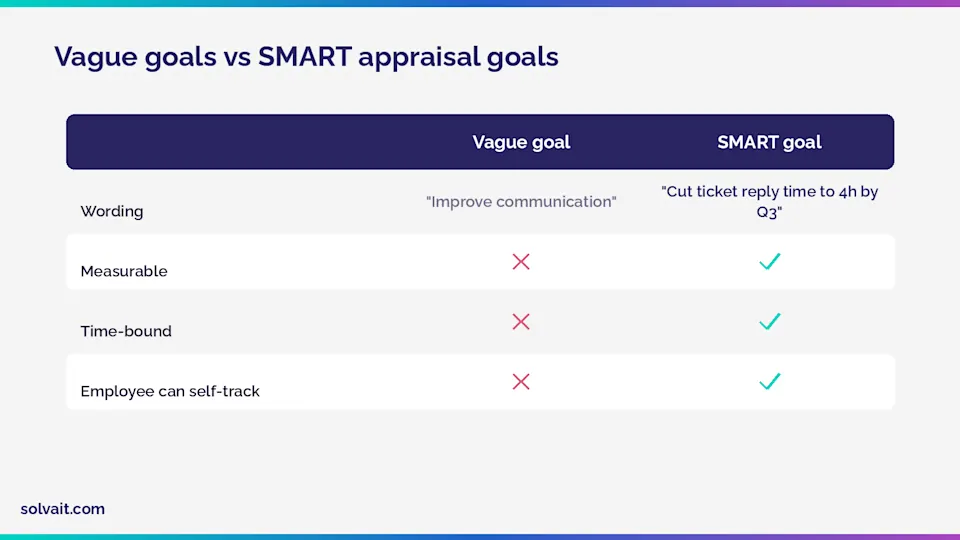
SMART isn't a management slogan. It's a practical filter. Specific: what exactly? Measurable: by what number? Achievable: realistic with the employee's resources? Relevant: does it serve a bigger goal? Time bound: by what date? A goal that passes those five gates becomes believable on its own, because the employee can track their progress without waiting for the manager's verdict at year end.
Here's the most common mistake: confusing activity with outcome. "Attend five training courses" is an activity. "Raise internal customer satisfaction from 72% to 85%" is an outcome. An employee can attend ten courses and improve nothing. Write goals around the result you want, not the steps you assume will get there.
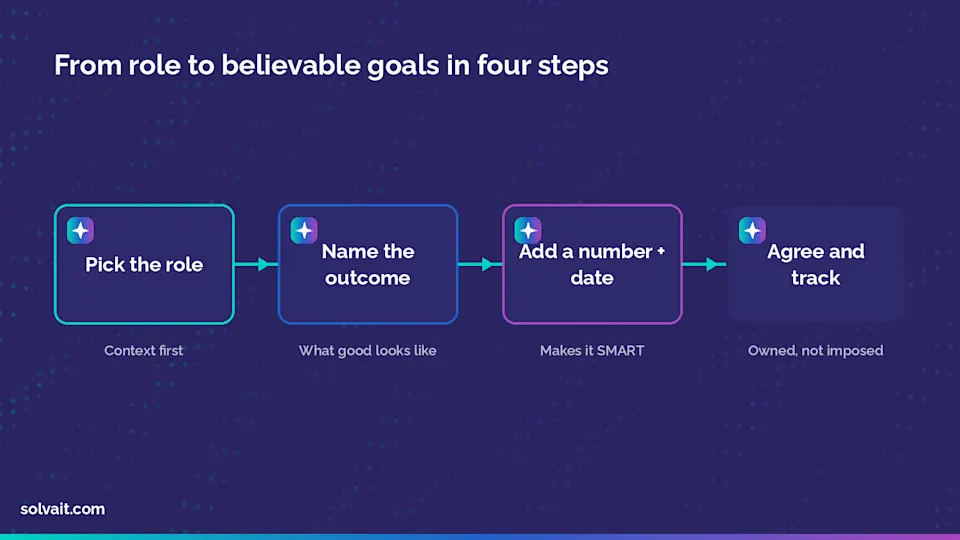
Four steps to a believable goal: start with the role and its context, name the outcome that means real success, add a number and a date to make it SMART, then agree on it with the employee instead of imposing it. That last step makes the difference. A goal the employee helped write, they own. A goal dictated to them, they resist.
How AI helps draft better goals
Writing five SMART goals for one role takes a manager thirty to forty-five minutes if they do it properly. Multiply that by twenty employees and you see why everyone falls back on copy paste from last year.
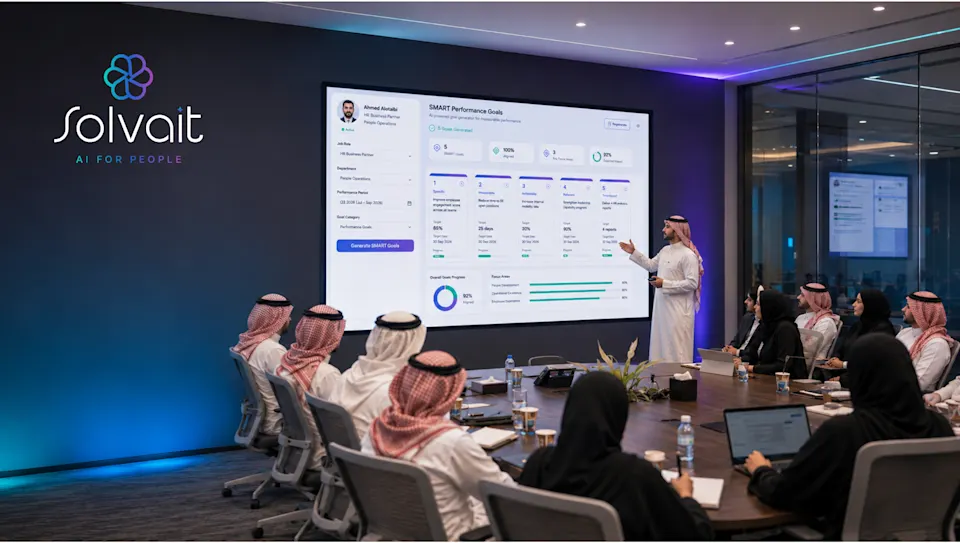
Agentic AI solves this. The agent reads the role, its level, and the team context, then proposes goals written to SMART criteria in seconds. The manager edits and approves, but starts from a strong draft instead of a blank page. The result is higher-quality goals in less time, and more importantly, goals that stay consistent across the whole team.
This is where Solvait Wise comes in, the performance platform built on Agentic AI. It generates measurable appraisal goals, checks each against SMART criteria, and links them to department and company objectives. The agent supports the decision, it doesn't replace it: the final evaluation stays with the manager, while drafting and alignment go to the AI.
Try the Free Appraisal Goal Generator now. Enter any job title and see five ready SMART goals in seconds, no signup. When you want to tie those goals to a full performance cycle across your team, book a demo.
FAQ
What's the difference between a vague goal and a SMART goal?
A vague goal describes a general wish like "improve performance" with no number or date. A SMART goal is specific, measurable, and time bound, such as "raise ticket close rate from 80% to 92% by the end of Q2." In practice, the employee can track their own progress on the SMART goal.
How many appraisal goals should an employee have?
Three to five goals per appraisal cycle is the practical range. More scatters focus, fewer may not cover the role's responsibilities. What matters is that each goal is measurable and linked to a bigger department or company objective.
Can you rely on AI to write appraisal goals?
Yes, as a starting point. Agentic AI drafts consistent SMART goals in seconds and ensures quality, but the manager stays responsible for reviewing, editing, and agreeing on them with the employee. The tool speeds the work; it doesn't remove the manager's judgment.
Why do employees dislike annual appraisals?
Because annual appraisals gather late feedback on vague goals that were often forgotten during the year. Employees feel motivated by continuous feedback and clear, trackable goals, not by a single year end review that decides their fate.
References
Gallup: via People Managing People: Performance Management Statistics, 2026 (only 2% say the system inspires improvement; 65% find appraisals irrelevant; 95% of managers dislike reviews)
People Managing People: 35 Performance Management Statistics That Matter In 2026, 2026 (77% motivated by continuous feedback; recognition programs cut voluntary turnover 31%; ideal range ~70%)
Deloitte: via The Role of OKRs in Fostering Employee Engagement, 2024 (only 53% of organizations consistently achieve their goals)
Ministry of Human Resources and Social Development: Progress in the Saudi Labor Market, 2025 (Saudi labor market context)
Ready to see Solvait in action?
Book a personalized demo and see how Solvait's AI-powered HR platform can transform the way your team works.
Tags
Related Posts

Future of HR in the GCC: 5 Predictions for 2027
Five practical predictions for the future of HR in the GCC by 2027, backed by Gartner, PwC , and what agentic AI means for Saudi and Gulf teams.
Aug 11, 2026
5 SMART Appraisal Goals in 30 Seconds
Solvait's free Appraisal Goal Generator writes 5 SMART goals for any role in 30 seconds with AI. No signup, no data captured.
Jul 13, 2026

OKRs and Vision 2030: Align Every Saudi Team
A practical guide to building OKRs tied to Vision 2030, comparing manual and AI goal setting, with steps to cascade goals from company to employee.
Jul 9, 2026