

Your HR Department Has Four New Colleagues, and They Never Sleep
An agentic HR department isn't one clever system. It's four specialized agents that split the operational work between them: a Compliance agent, an Operations agent, a Payroll agent, and a Concierge agent. Agentic HR is a model in which autonomous AI agents run HR processes end to end, from a compliance check to a payroll calculation, over a deterministic calc engine and under human oversight. The point isn't to have a model guess someone's pay. It's to have an engine that reads written rules and returns the same output for the same inputs, every time.
That distinction matters because the market is full of tools that call themselves "AI in HR" while doing nothing more than answering questions. An agent is different. It plans, uses tools, and runs the task to close. Gartner says the share of enterprise applications embedding task-specific agents will jump from under 5% in 2025 to around 40% by the end of 2026. That's one of the fastest enterprise technology shifts since the move to cloud.
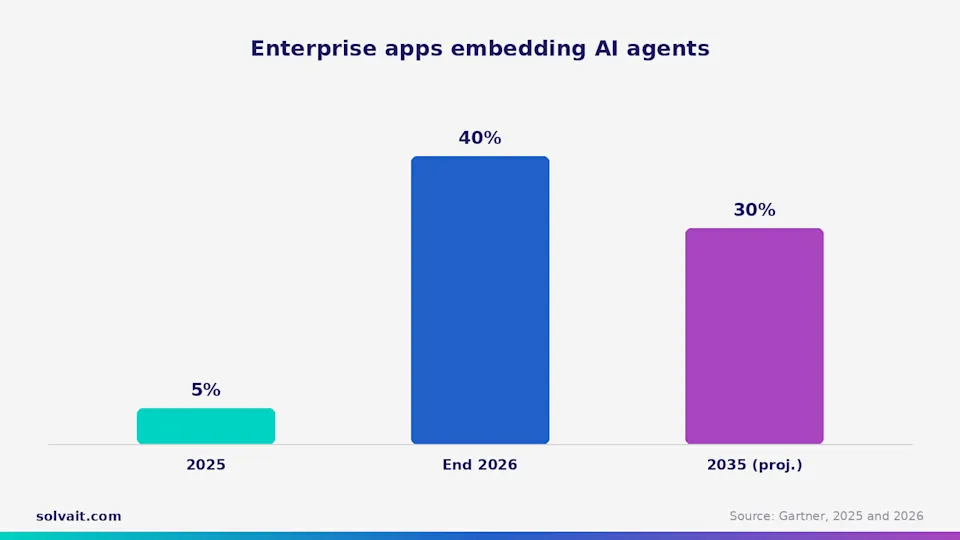
The four agents: who does what
In an agentic design, there's no single giant "system" trying to do everything. There are four agents, each with a clear responsibility, all talking to the same engine.
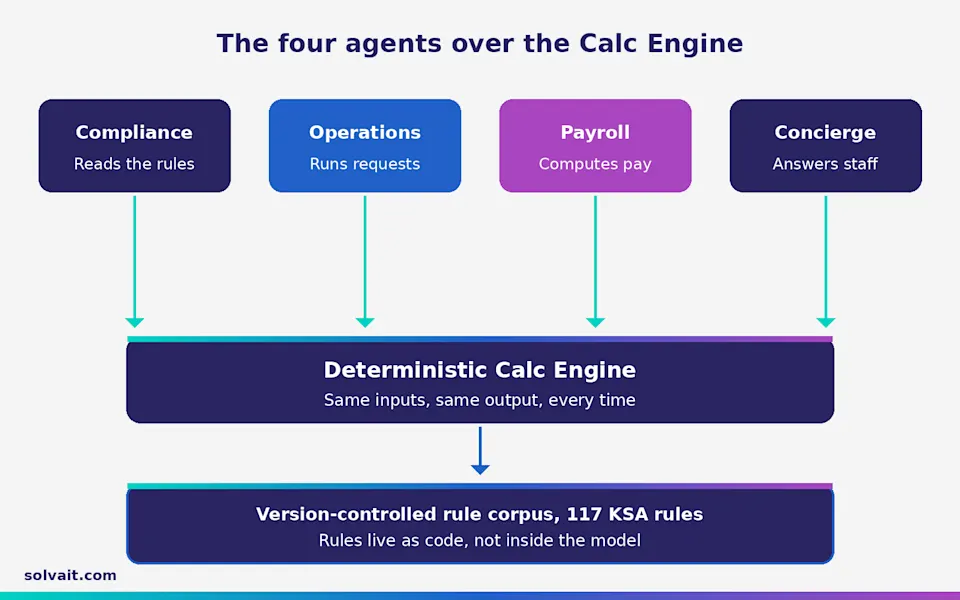
The Compliance agent reads the rules. Saudi Labor Law, GOSI and WPS requirements, and internal company policy are all expressed as rules this agent checks before any action goes through. The Operations agent handles the daily requests: leave, excuses, profile updates. The Payroll agent computes wages, allowances, and deductions. And the Concierge agent answers employees in Arabic, and runs the request rather than just replying to it.
None of the four invents its own logic. They all call one engine in the middle. That's where the real difference lives.
Why a model should never "do the math" on your payroll
In a lot of tools marketed as "AI," the rule is buried inside the model. Nobody can open it, confirm it was applied correctly, or explain it to an auditor. That's fine when the system drafts an email. It's dangerous when it computes someone's pay.
In a sound agentic design, the rules live as version-controlled code, not inside the model. The engine reads them and resolves them deterministically: the same inputs give the same result, every time, with no surprises. In Solvait's agentic HR platform, the Saudi rule corpus holds 117 source-validated rules, and the Arabic text of the Labor Law is the authoritative source, not an English translation of it.
The difference isn't philosophical. Manual payroll numbers cost money. An Ernst & Young survey of payroll practices found that organizations still relying on traditional, non-automated processes see close to a 20% error rate, with each mistake costing an average of $291 to identify and correct. When a deterministic engine computes instead of a manual spreadsheet, those errors disappear at the root.
An assistant answers. An agent acts.
The easiest way to grasp the value: compare an ordinary AI assistant with an agentic agent.
Dimension | AI assistant | Solvait agentic agent |
The task | Suggests and answers your question | Plans and runs the task to close |
Payroll | Explains how it's computed | Computes it via a deterministic engine |
The trace | A text answer | A number tied to its rule version and source |
Oversight | The human does it all | The human oversees, the agent executes |
The third row is the one that counts. When a number comes out of the Payroll agent, its trace comes with it: the rule version that was applied, the inputs that went into the calculation, and the Labor Law article it rests on. When an auditor asks "why was this amount paid?", you have an answer you can open and read, not a guess.
What gets freed up when agents take the work
HR teams drown in repetitive admin. Deloitte's research on HR modernization found that HR teams spend up to 57% of their time on routine administrative tasks: updating records, processing forms, answering the same questions on repeat. That's time not going to retention, to culture, or to the strategic work the team was hired to do in the first place.
When the Operations agent takes the daily requests, the Concierge agent takes employee questions, and the Payroll agent takes the calculations, the team gets most of that time back. Managers oversee the decisions that matter instead of chasing forms. That isn't shrinking HR's role. It redirects it toward work that deserves a human.
The part everyone gets wrong: governance
Here's the warning that saves you a failed project. Enthusiasm for agents pushes a lot of companies to deploy them with no controls, and the outcome is predictable. Gartner expects over 40% of agentic AI projects to be canceled by the end of 2027, due to rising costs, unclear business value, or weak risk controls. In its 2026 analysis, governance and security show up as a leading enterprise concern early in the adoption cycle, not after large-scale deployment.
The lesson is practical: an agent with no auditable trace isn't an asset, it's a liability. That's why the trace is built into the design from day one: every calculation traces back to its rule version, inputs, and source, and human oversight stays on the decisions that matter. The agent runs the repetitive work, but the human stays in the loop where they should.
Honestly, agents won't fix vague policy. If your leave or allowance rules are unclear, the agent will just execute the ambiguity faster. The real value shows up when the rule is clear, written, reviewable, and the agent enforces it consistently.
Where this sits in the Saudi market
Solvait is building agentic HR for the Saudi market first, on Microsoft Dynamics 365. And the architecture is designed to extend across the Gulf: the UAE, Egypt, and the rest of the GCC attach through the same engine and the same rule format. You build compliance once and extend it as your footprint grows.
If you're building end-to-end HR, Solvait's human capital management platform is the foundation all of this sits on. For a deeper read on how agentic AI reshapes the team's work, see how agentic AI ends the HR team's overload.
To see the agents run on data that looks like your own environment, book a demo with Solvait.
FAQ
What is agentic HR?
Agentic HR is a model in which autonomous AI agents run HR processes end to end, from a compliance check to a payroll calculation, over a deterministic calc engine and under human oversight. The agent runs the task rather than just answering a question about it.
What is the difference between an AI assistant and an agentic agent?
An assistant suggests and answers your questions while you still do the work. An agent plans the task, uses tools, runs it to close, and reports back. In payroll, for example, an assistant explains how pay is computed, while an agent computes it through a deterministic engine.
Can AI compute payroll reliably?
In a sound design, the model doesn't compute payroll. The rules live as version controlled code, and a deterministic engine resolves them, returning the same output for the same inputs. Every number traces back to its rule version, inputs, and source, so it's auditable rather than a guess.
Does the human still have a role in agentic HR?
Yes. Agents run the repetitive work, but human oversight stays on the decisions that matter. Gartner warns against deploying agents without governance and expects over 40% of agentic AI projects to be canceled by 2027 due to weak controls. An auditable trace plus human oversight is what makes a deployment succeed.
References
Gartner — Gartner Predicts 40% of Enterprise Apps Will Feature Task-Specific AI Agents by 2026, 2025 (the jump from 5% to 40%).
Gartner — Over 40% of Agentic AI Projects Will Be Canceled by End of 2027, 2025 (governance risk).
Gartner — 2026 Hype Cycle for Agentic AI, 2026 (governance and security surface early).
Ready to see Solvait in action?
Book a personalized demo and see how Solvait's AI-powered HR platform can transform the way your team works.
Tags
Related Posts
Inside Tashghil: The Operations Agent for HR Automation
Tashghil, Solvait's operations agent, runs leave, advance automatically within guardrails, while your team keeps the call. Here's how.
Sep 22, 2026
Cross Department Coordination: An AI Playbook
How Saudi holding companies coordinate across subsidiaries with agentic AI,and where to start without rebuilding your systems.
Aug 3, 2026
How Agentic AI Eliminates HR Team Burdens
How agentic AI is reshaping HR team size in Saudi Arabia and the GCC. What agents take over, what humans keep, and the ROI behind a leaner HR team.
Aug 2, 2026