

Solvait Wise 30 Day Action Plan: What It Actually Looks Like
A 30 day action plan is a time boxed list of specific actions that Solvait Wise builds to turn org structure insight into steps you can execute within a month, split into three tiers: quick wins, high priority actions, and next quarter setup. The idea is simple at its core: analyzing your org structure alone changes nothing. A dashboard telling you a manager has 15 direct reports is useful, but it stays a data point until it becomes a decision. The 30 day plan is the bridge between insight and action.
This guide walks through how the plan is built, why it starts with a 30 day window in particular, and how everything the agent spots becomes an action a human leader approves.
Why 30 days in particular
The short window isn't a marketing choice. It's what the transformation research says. McKinsey found that initiatives executed in the first six months of a transformation program deliver 57% of its total value. Speed isn't a luxury. It's what builds the momentum that carries the rest of the change.
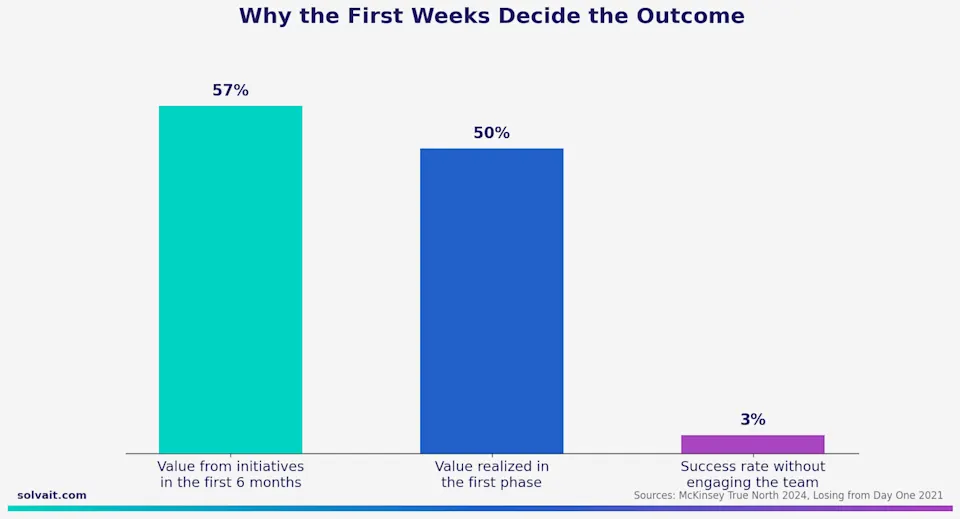
The deeper lesson is that a transformation that starts slow rarely catches up. McKinsey's "Losing from Day One" report noted that about half of any transformation's value is realized in its first phase, and that fewer than a third of transformations succeed at both improving performance and sustaining it. The start decides a lot.
That's why the 30 day plan is designed to produce tangible value fast, instead of waiting on a big project that may never finish. It follows another principle McKinsey documented: three quarters of "very successful" transformations broke the process into small, clearly defined initiatives, not one giant plan. The three tiers are that principle in practice.
The three tiers: from quick win to next quarter
Solvait Wise doesn't hand you a random task list. It sorts actions by effort and impact into three clear tiers.
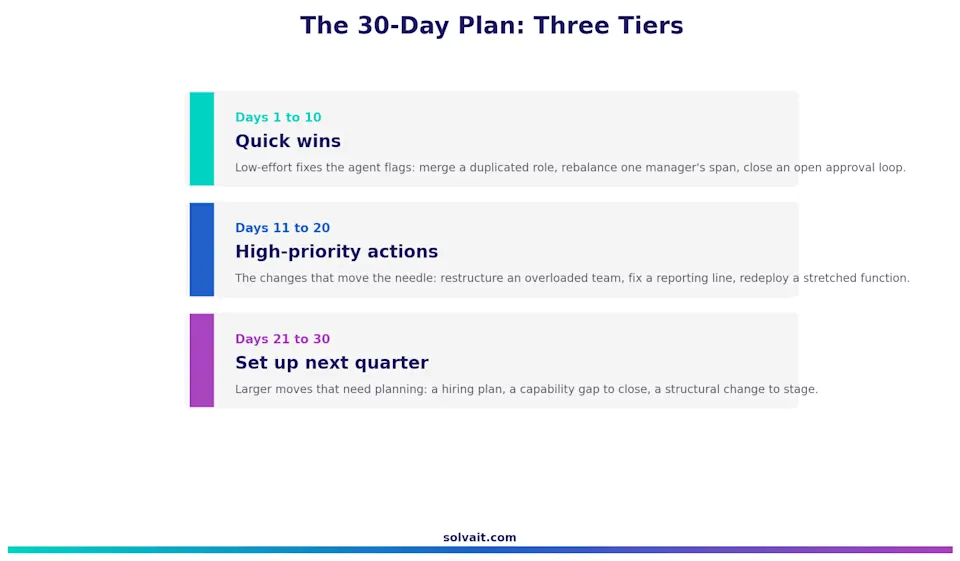
Tier one (days 1 to 10) is for quick wins: low effort fixes the agent flags, like merging a duplicated role across two subsidiaries, rebalancing an overloaded manager's span, or closing an approval loop that's been open for weeks. These wins build trust and show immediate impact.
Tier two (days 11 to 20) is for high priority actions: the changes that move the needle but take more effort, like restructuring an overloaded team, fixing a broken reporting line, or redeploying a function stretched across two units.
Tier three (days 21 to 30) sets up the next quarter: bigger moves that need planning, like a hiring plan to fill a gap, a capability gap to close, or a structural change to stage for later. The plan doesn't execute everything in a month. It does what can be done and lays the groundwork for what follows.
Tier | Timeframe | Nature of the action |
Quick wins | Days 1 to 10 | Low effort fixes, immediate impact |
High priority actions | Days 11 to 20 | Needle movers, medium effort |
Next quarter setup | Days 21 to 30 | Bigger moves that need planning |
How what the agent spots becomes an action
The plan isn't a magic box. It's a clear four step sequence, from reading the org to a human decision.
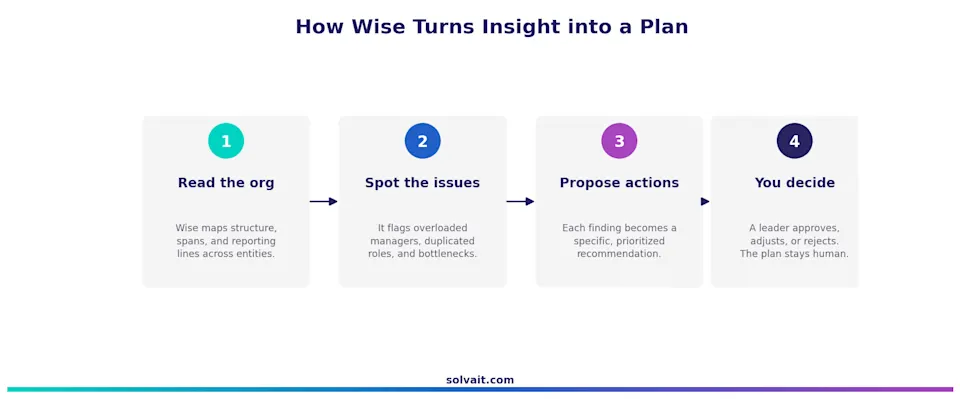
First the agent reads the org: it maps structure, spans, and reporting lines across entities into one data layer.
Second it spots the issues: overloaded managers, duplicated roles, bottlenecks a person can't see because they're spread across several systems.
Third it proposes actions: each finding becomes a specific, prioritized recommendation, not a generic alert.
Fourth, and most important, you decide: the leader approves the recommendation, adjusts it, or rejects it.
That last step isn't a detail. McKinsey's research showed that transformations which fail to engage managers and employees succeed only 3% of the time. A plan imposed by a system that people don't own dies in execution. So the decision stays with a human, always. The agent proposes; it doesn't impose.
Where Solvait fits
This is exactly what Solvait Wise delivers: it doesn't just map your org structure, it turns it into a prioritized action plan a leader approves. It reads the structure across entities, detects supervision loads and bottlenecks, and proposes specific improvements sorted across the three tiers of the 30 day plan. Built on Microsoft Dynamics 365, it stays inside an environment your IT team already knows.
The difference between an organization with a dashboard and one with an action plan isn't the volume of data. It's whether a party turns the insight into ordered steps. Explore Solvait Wise to see how it builds the 30-day plan, and book a demo on your organization's data.
FAQ
What is the 30 day action plan in Solvait Wise?
It's a time boxed list of specific actions that Solvait Wise builds to turn org structure insight into steps you can execute within a month, split into three tiers: quick wins in the first days, high priority actions mid month, and next quarter setup at the end.
Why 30 days and not longer?
Because speed creates value. McKinsey found that initiatives executed in the first six months deliver 57% of a transformation program's total value, and that a transformation which starts slow rarely catches up. The 30 day window produces tangible impact fast and builds momentum.
Does Solvait Wise execute the plan automatically?
No. The agent detects, proposes, and prioritizes, but every action waits for a human leader to approve, adjust, or reject it. This human in the loop design is essential: transformations that people don't own succeed only 3% of the time, per McKinsey.
How is an action plan different from a dashboard?
A dashboard shows data and waits for someone to read it and decide. An action plan turns every finding into a specific, prioritized recommendation with a timeframe. The first tells you a problem exists; the second proposes the exact next step, ordered by effort and impact.
Who benefits most from the 30 day plan?
HR leaders, CEOs, and transformation teams in multi entity organizations, where overlap and bottlenecks across subsidiaries are hard to see. The plan gives them a clear path to start without waiting on a large transformation project.
References
McKinsey & Company: Defining your true north: A road map to successful transformation, 2024 (57% of value from first six months initiatives).
McKinsey & Company: Losing from Day One, 2021 (half of value in the first phase, fewer than a third of transformations succeed).
McKinsey & Company: The science behind successful organizational transformations, 2021 (3% success without engaging the team, breaking work into initiatives).
McKinsey & Company: The State of AI, 2025 (redesigning the workflow around agents).
Ready to see Solvait in action?
Book a personalized demo and see how Solvait's AI-powered HR platform can transform the way your team works.
Tags
Related Posts

Future of HR in the GCC: 5 Predictions for 2027
Five practical predictions for the future of HR in the GCC by 2027, backed by Gartner, PwC , and what agentic AI means for Saudi and Gulf teams.
Aug 11, 2026

How Agentic AI Eliminates HR Team Burdens
How agentic AI is reshaping HR team size in Saudi Arabia and the GCC. What agents take over, what humans keep, and the ROI behind a leaner HR team.
Aug 2, 2026
How AI Spots Org Bottlenecks Meta
How AI reads your org chart and surfaces the broken span of control before it costs you.
Jul 30, 2026