
Span of Control: How AI Spots the Bottleneck Before It Costs You
Span of control is the number of employees who report directly to a single manager. When that number climbs past what a manager can actually handle, the problems start: slower decisions, weaker team development, and a manager burning out while trying to give everyone the attention they need. The catch is that this imbalance never shows up in one clean report. It shows up late, as resignations and stalled projects, after the cost has already been paid. Agentic AI flips that order. It reads the full org chart and flags the overloaded manager before the load turns into turnover.
Executives in the Kingdom know this pressure well. Holding companies and giga-projects under Vision 2030 scale faster than management layers can be built. The result: managers running teams larger than they should, and a structure growing sideways while nobody notices where the bottleneck formed.
The problem isn't the number, it's who's carrying it
The number alone won't tell you enough. The average number of direct reports per manager rose from 10.9 in 2024 to 12.1 in 2025, a jump of nearly 50 percent since Gallup started measuring in 2013. The reason is well known: companies are consolidating middle management layers and widening how many people report to each remaining manager.
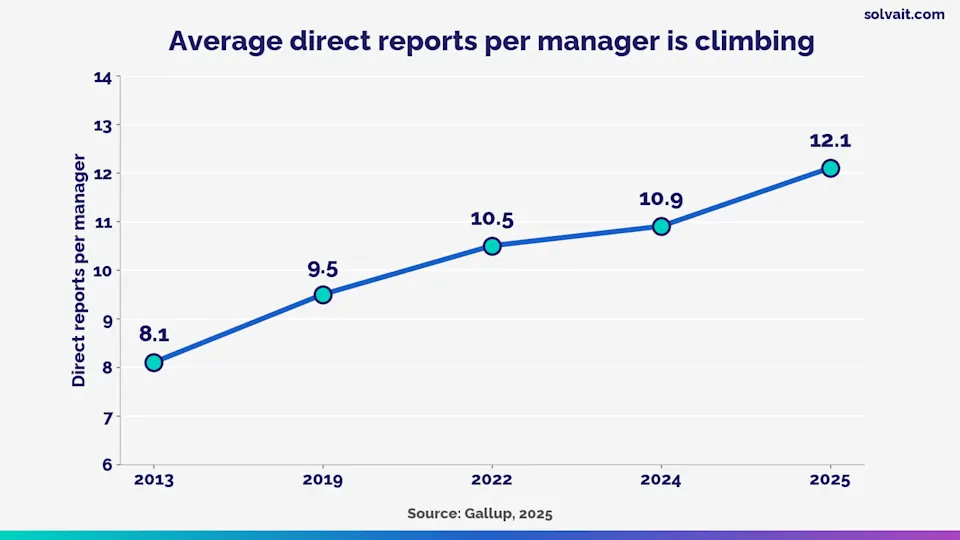
But that average hides more than it reveals. The median still sits at five to six reports, which means a minority of very large teams is pulling the average up. Put differently: your organization's average can look perfectly healthy while one or two managers carry double what they can handle. The average reassures you, and the burned out manager resigns.
Here's the distinction that matters. The question isn't "how many reports on average?" It's "where is the overloaded manager, and what kind of work do they do?" A manager leading a team on standardized work can handle a far wider span than one developing a team on complex work.
Why human intuition misses this
An HR leader never sees the whole structure at once. They see the departments they touch, and they hear about bottlenecks when those bottlenecks explode. Agentic AI reads the entire organization in one pass: every manager, every span, and the type of work in each branch, then flags the bottlenecks before they land on your desk as a resignation letter.
The financial cost of getting this wrong is real. Organizations with poorly designed spans see 40 percent higher turnover and 23 percent slower project delivery, per Happily.ai's analysis of 200 plus companies. And managers with seven or fewer direct reports score 20 percent higher on team engagement than those managing fifteen or more.
There's no magic number, there's a model that matches the work
The common mistake is forcing one number onto every manager in the company. The right move is to match the span to the manager's type of work. McKinsey built a model that ties the right span to the nature of the managerial job, and it deserves to anchor any structural decision.
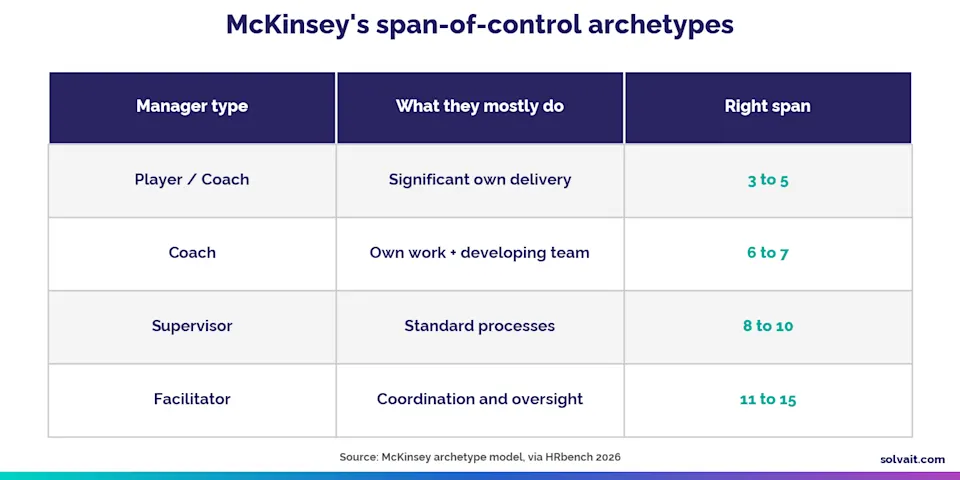
A manager doing significant individual delivery alongside their leadership can't carry more than three to five reports. A facilitator whose job is coordination and oversight can carry up to fifteen. Applying a supervisor's span to a player coach is a direct route to burnout. That distinction is hard for the human eye to make across hundreds of managers, and easy for AI to make in seconds.
What the AI actually does
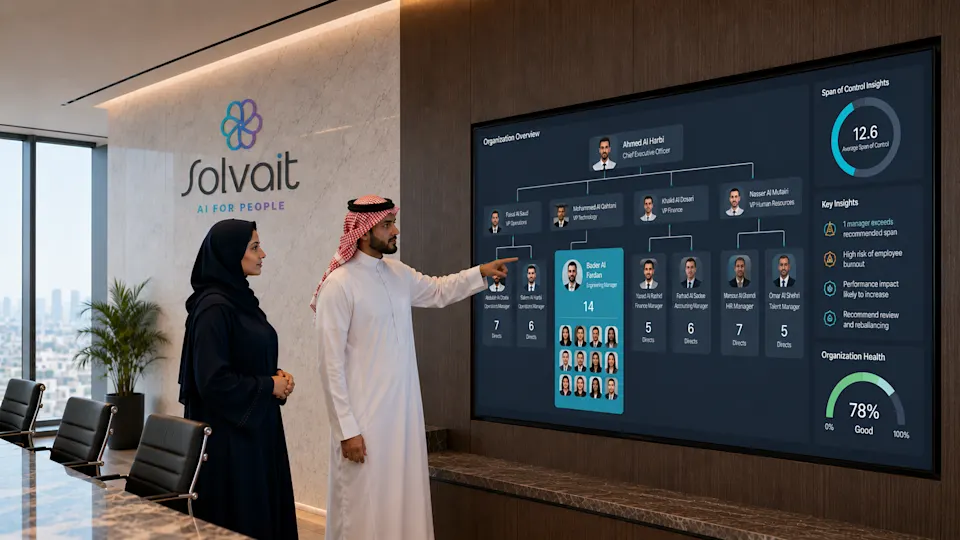
The system reads the org chart, calculates each manager's span, classifies the type of work, then raises an alert when a manager exceeds the right span for their role. It doesn't decide for you. It shows you where to look: which manager is overloaded, how many reports too many, and where it's worth adding a supervisor layer or redistributing.
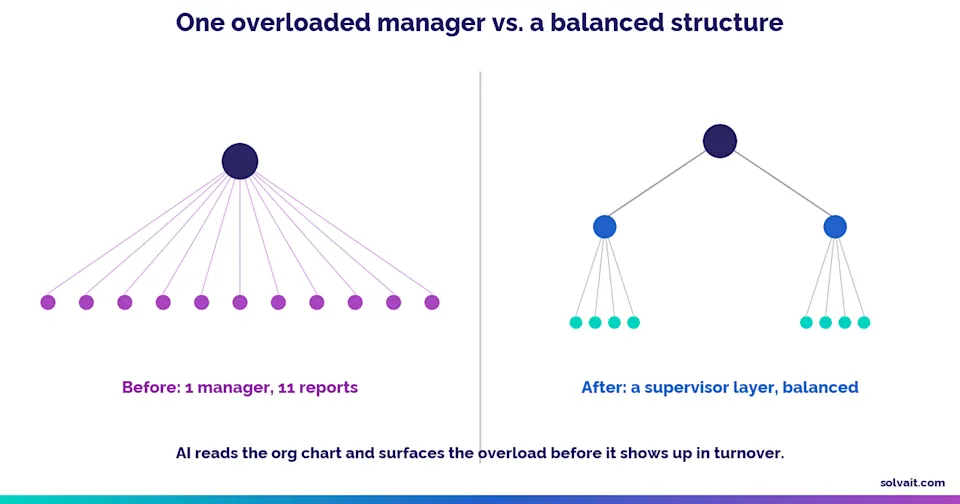
Take the example above. A manager leading eleven reports in work that needs close follow-up. Intuition might let that slide for months. The AI raises it immediately and suggests the redistribution: a middle supervisor layer, with balanced spans beneath it. The decision stays yours, but the bottleneck became visible before it cost you.
From diagnosis to decision
Knowing where the bottleneck is gets you halfway. The other half is tying it to a decision: do you add a manager? Redistribute a team? Merge a layer? That's exactly what Solvait Wise builds as a full layer on top of the diagnosis. It reads the structure, spots the broken span of control, and recommends reorganization steps tied to performance and goals, so the finding doesn't stay a report on a shelf but becomes an executable decision.
In a market where Saudi organizations are scaling at Vision 2030 pace, seeing the structure clearly before it stalls isn't a luxury. It's the difference between a project that launches on time and one that slips because a single manager was carrying double their capacity and nobody noticed.
The decision is yours, the visibility is the AI's
AI doesn't replace the leader in a structural decision. Cultural fit, team history, and a specific manager's ability to stretch are all human judgments. What AI does is hand you the full, clear map, so you spend your judgment on the right decision instead of spending it discovering the problem too late.
If you want to see how Solvait Wise reads your org structure and surfaces the bottlenecks, explore Solvait Wise up close. And when you're ready to see it on your own structure, book a demo with Solvait and we'll walk through it step by step.
FAQ
What is span of control?
Span of control is the number of employees who report directly to a single manager. It directly affects decision speed, team engagement, management costs, and turnover, which makes it one of the most consequential metrics in organizational design for any company.
What is the ideal number of direct reports per manager?
There's no single number. Most organizations target a span between 5 and 10 reports, but the right number depends on the work: 3 to 5 for complex work, and 11 to 15 for standardized, coordination heavy work. Matching the span to the type of work matters more than any fixed number.
How does AI help with organizational structure analysis?
AI reads the full structure, calculates each manager's span, classifies their type of work, then raises an alert when a manager exceeds the right span for their role. This surfaces bottlenecks before they show up in turnover, and turns the diagnosis into an executable reorganization decision.
Why does span of control matter for Saudi organizations?
Holding companies and giga projects under Vision 2030 scale faster than management layers can be built, creating managers who lead teams larger than they can handle. Seeing the bottleneck early means projects that launch on time, budgets that hold, and long term competitiveness.
Does AI replace the leader's decision on structure?
No. AI hands you the full, clear map of spans and bottlenecks. The final decision, which weighs cultural fit, each manager's capacity, and team history, stays human. The AI's role is to guide your judgment, not replace it.
References
Gallup: Span of Control: Optimal Team Size for Managers, 2025 (backs the rise from 10.9 to 12.1 and the 5 to 6 median)
McKinsey: Span-of-control archetype model, via HRbench, 2026 (backs the span-by-work-type archetypes)
Lattice: Span of Control benchmarks, via HRbench, 2026 (backs the trend toward flatter structures)
Bureau of Labor Statistics: Manager-to-employee ratio, via Gallup, 2025 (backs the one-manager-per-11.5-employees ratio)
CSIS: Saudi Arabia's Strategic Vision, 2026 (backs PIF and holding-company expansion under Vision 2030)
Ready to see Solvait in action?
Book a personalized demo and see how Solvait's AI-powered HR platform can transform the way your team works.
Tags
Related Posts

Solvait Wise 30 Day Action Plan: How It Works
How Solvait Wise turns org structure insight into a practical 30 day action plan: with sourced numbers and clear steps.
Aug 6, 2026

Future of HR in the GCC: 5 Predictions for 2027
Five practical predictions for the future of HR in the GCC by 2027, backed by Gartner, PwC , and what agentic AI means for Saudi and Gulf teams.
Aug 11, 2026

Cross Department Coordination: An AI Playbook
How Saudi holding companies coordinate across subsidiaries with agentic AI,and where to start without rebuilding your systems.
Aug 3, 2026